
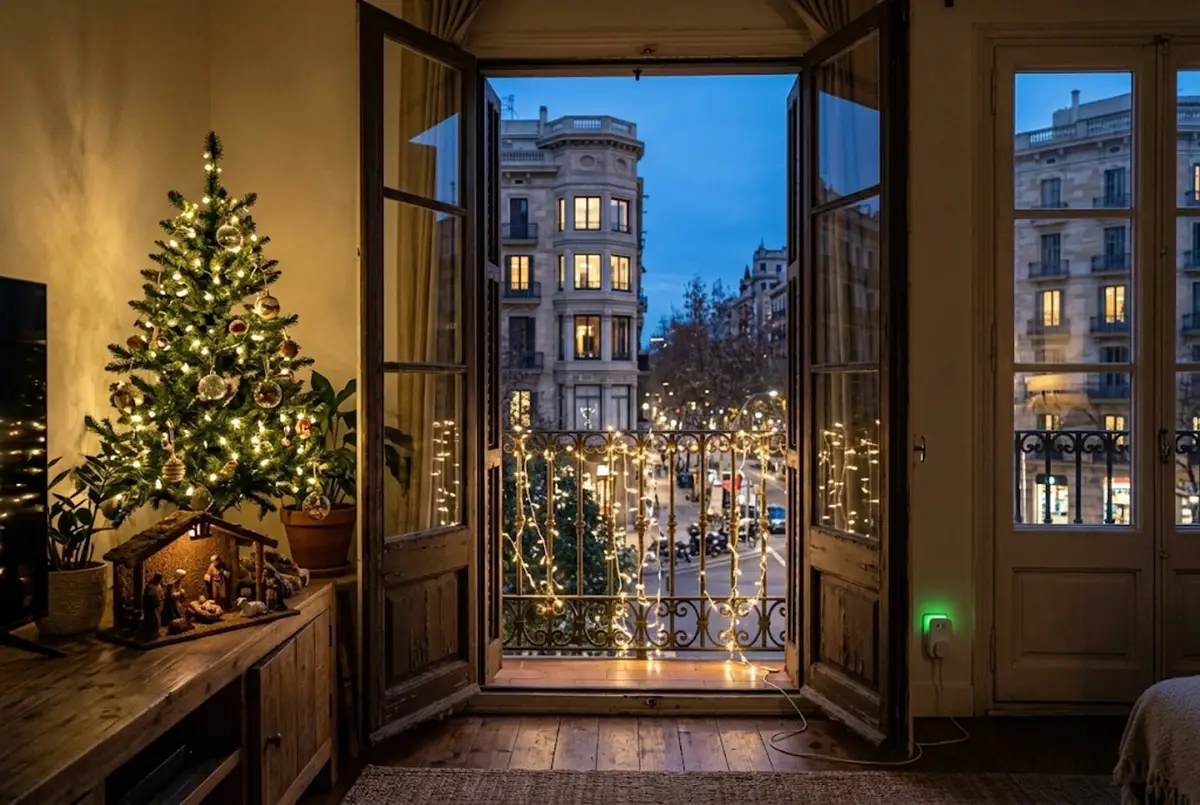
Every December the same scene plays out. The balcony lights are on at three in the afternoon because someone plugged them in that morning, or off until nine because nobody remembered. The tree stays lit all night in an empty living room. And the old mechanical plug-in timer bought years ago switches on at seven when it should be five, because the last power cut stopped it and nobody has reset it since.
Automating Christmas lights is one of the simplest things you can do at home: one smart plug per group of lights and a couple of rules. But it's worth being clear about the priorities. Having them switch on by themselves is the nice part; having them switch off by themselves is the important part.
What Catalonia's civil protection service advises
Every year, the Generalitat's civil protection service (Protecció Civil) publishes advice on Christmas decorations on its Christmas holidays page (in Spanish). Four points relate directly to lights:
- Switch off lights and candles when you go to bed or when you go out.
- If you put lights on balconies or terraces, use bulbs designed for outdoor use.
- Avoid overloading power strips.
- Check that cables, plugs and lights are in good condition.
The first is the one most often ignored — not out of carelessness but tiredness: at midnight, nobody is thinking about the tree. It's exactly what a scheduled home does better than a person. The other three aren't really about home automation but about buying well and checking things before you hang anything up, though they do shape how the balcony is set up.
On at dusk, not at a fixed time
At this time of year the sun sets very early in Barcelona and at almost the same time every day: around 17:22 in early December — the earliest sunset isn't on the 21st but around the 8th — and just after 17:35 on 6 January. So, to be honest, a fixed time isn't far off. The advantage of switching on at sunset is something else: the system works it out on its own every day, with nobody adjusting anything, and it can take the real light into account. On a rainy December afternoon it's already dark at five, and a light sensor brings the switch-on forward. We explain how the two signals work — the astronomical calendar and the light coming in — in our post on lights that turn on by themselves at dusk.
The mechanical timer has two problems that have nothing to do with the time of day. Each one has its own clock, so the tree, the nativity scene and the balcony end up out of step with each other. And when the power goes off, it stops and carries on counting from where it left off: from that day on it switches on at the wrong time without anyone noticing. A connected plug sets its own clock.
Off by themselves: at bedtime, when you go out, and just in case
Switching off is where automation earns its keep. There are three ways to do it, and it's worth using all three together:
- At bedtime. A goodnight button by the bed or on your phone — or the same scene that already switches off the rest of the house — also turns off the tree, the nativity scene and the balcony. Nobody has to go back through the living room.
- When you go out. When the last person leaves, the Christmas lights go off with everything else. If you come back after dark, they come on as you arrive.
- A cut-off time. In case someone falls asleep on the sofa or forgets the button: at a fixed time — one in the morning, say — anything still on is switched off.
The balcony deserves its own rule. Outdoor lights are seen by the neighbours too, and shine into their windows: the sensible thing is for them to go off before the indoor ones, around midnight, even if you're still up. On Christmas Eve and New Year's Eve, the exception is a single tap away.
The balcony: outdoor lights and an outdoor plug
The balcony is the tricky part, because it combines electricity, rain and weeks of use. First, as civil protection advises, outdoor lights: indoor ones aren't designed to get wet. Second, where they plug in. If there's a socket indoors by the balcony door, the smart plug goes there, under cover, and only the light string's cable goes outside. If you have to plug in on the balcony itself, it needs to be an outdoor plug with protection against splashing water (IP44 or higher) and, if possible, under the overhang.
Two things we often see. The cable running out through the balcony door shouldn't get pinched when it's closed: over the weeks, the insulation gets crushed and wears through. And no power strips daisy-chained one after another to reach everywhere. If the residual-current device trips when it rains, the usual suspect is that very plug or connection outside; we explain it in what happens to your smart home in a power cut. Then it's a matter of checking the signal reaches: a smart plug on the balcony, behind a thick façade wall, sometimes needs a repeater closer by.
The tree, the nativity scene and the balcony in one go
The convenient set-up is one plug per group — tree, nativity scene, balcony, window — and a "Christmas" scene that switches them all on and off together. Each group can also have its own schedule: the balcony from dusk to midnight; the tree and nativity scene from dusk to bedtime.
And the whole season is scheduled in one go, with a start and an end date: from the early-December bank holidays to after Epiphany, for example. Within that period, they come on by themselves every evening; outside it, they stop coming on even if they're still plugged in during January. Next year, you change the dates and that's it.
A practical point before you buy new lights: many remote-controlled light strings, when the plug gives them power again, start in their factory mode, which is usually a flashing one. The ones that remember their last mode work perfectly with a smart plug; with the rest, it's worth testing first.
How much they really use
LED light strings use little power, far less than the old bulb-type ones, but "little" depends on how many there are and how many hours they're on. A metering plug tells you without guessing: the real watts of each group and the total for the whole season. That's useful in two ways. First, for deciding: if the balcony ones are old bulb-type strings, you'll see the difference in watts and know which to replace next year. Second, for keeping watch: a group drawing power at three in the morning is a group that hasn't switched off.
If you're away for Christmas
If you're spending the holidays away, it's tempting to leave the Christmas lights coming on every evening so it looks as though someone's home. To be consistent with civil protection's advice — switch them off when you go out — we don't recommend it: a balcony light string left on for weeks in an empty home is exactly the risk you want to avoid. The decorations stay off, and presence is simulated with the home's normal lights and blinds, at times that change every day, as we explain in our guide to simulating presence at home. The home's own lights are made for that.
What you need (and how we quote for it)
Not much: one smart plug with power metering per group of lights, an outdoor one if the balcony needs it and, if you like, a light sensor. It all goes into the same system as your home's smart lighting, so the goodnight button or leaving the house also switches Christmas off. It works locally, and if you already have the system installed, it's just a matter of adding the plugs and scheduling the season.
We don't give a fixed figure here, because it depends on how many groups of lights there are and what you already have at home. We quote for it during the visit, with no obligation, as a one-off payment with no monthly fees. It comes with the same warranty as everything else we install: we guarantee our installation and configuration for 5 years. The devices carry their manufacturer's warranty (2–3 years), and we handle it for you.
Common questions
Will any smart plug do for Christmas lights?
For the tree and the nativity scene, almost any: LED strings use little power and don't need anything special. What's worth having is one that measures power, so you can see what each group uses and whether something has been left on. For the balcony, the plug has to be under cover or rated for outdoor use, with protection against splashing water, and the lights have to be outdoor lights, as Catalonia's civil protection service points out. And one plug per group of lights is better than a power strip with everything hanging off it.
Can I set up the whole season and forget about it?
Yes, and it's the most convenient way. You set a start date and an end date — for example, from the early-December bank holidays to after Epiphany on 6 January — and within that period the lights come on at dusk and go off on their own every night. When the season ends, they stop coming on even if you forget to unplug them, and next year you just change the dates.
My lights have a remote and flashing modes — will they work with a smart plug?
They will, with one thing worth testing first: the plug switches the power on and off, and many remote-controlled light strings, when the power comes back, start in their factory mode, which is usually a flashing one. The ones that remember their last mode are no trouble at all; with the rest, either you can make your preferred mode stick, or you accept that they'll start up flashing. We check it during the visit with your own lights.
Do they still work if the internet goes down?
Yes. The schedule, the sunset time and the goodnight switch-off are worked out on the small device in your home, without going through any outside server. You only need the internet to switch them on or off from outside the house and to get any alerts on your phone.
If they're LED, can I leave them on all night?
Better not. Catalonia's civil protection service advises switching Christmas lights off when you go to bed and when you go out, and being LED doesn't change that advice: the risk isn't just in the bulbs, but in the cables, power strips, transformers and connections that stay plugged in for weeks, sometimes outdoors. Setting them to switch themselves off is exactly how you follow that advice without relying on anyone's memory.
In short
Christmas lights are the easiest automation of the year and one of the most appreciated. Having them come on at dusk is convenient; having them switch off by themselves at bedtime and when you go out is what civil protection advises and what people forget most. With one plug per group, a scene, the season's dates and outdoor lights on the balcony, Christmas switches itself on and off without anyone having to remember. This year, let the house turn off the last light.