
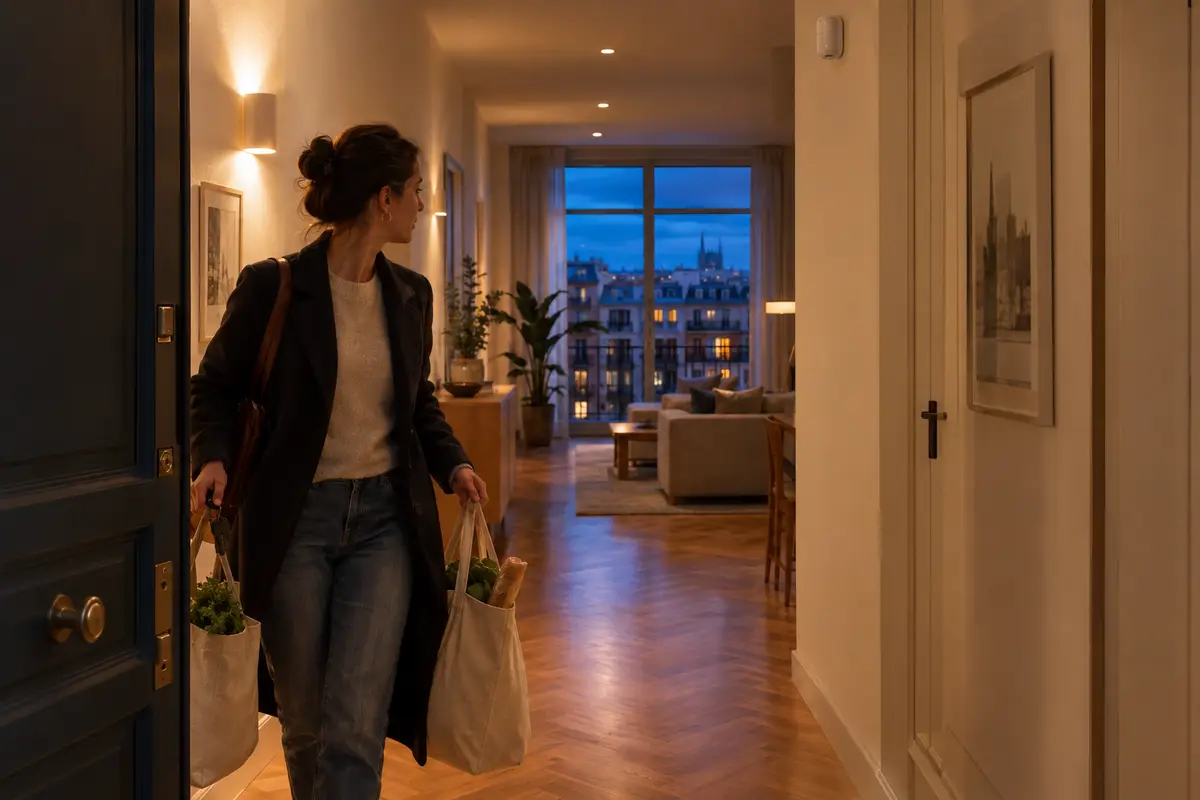
It's half past six in the evening, it's still September, and you're already coming home in the dark. You open the door with the shopping bags in one hand and your keys in the other, and do what you always do: feel your way along the wall until you find the switch. On 25 October the clocks go back and that scene shifts a full sixty minutes earlier; from November onwards, everything you do at home after half past five, you'll do by artificial light.
There's a better way to get through the autumn: the lights already on when you get home, and coming on by themselves whenever the house needs them — at dusk, when you walk into a room, when you get up in the early hours — without anyone having to think about it. We're not talking about a stairwell sensor that cuts out after thirty seconds, but about a home that turns on just the right light, in just the right place, and steps aside when you take over. This is the guide to getting it right.
Three ways for the lights to turn on by themselves
There are three different signals a home can use to decide when to turn a light on, and the difference between a system that drives you mad and one you never even notice comes down to which one is used where — and, above all, to combining them.
By the actual time of sunset. Not a fixed schedule you have to tweak every month, but the moment the sun sets in Barcelona on every day of the year: the system knows it from an astronomical calendar and corrects itself, including on the day the clocks change. It's the perfect signal for anything you want on every evening, no matter what: the living-room lamp, the light by the front door, the balcony.
By how much light there really is. A light sensor measures how much daylight is coming in, so the house responds to what's happening outside rather than to the calendar: a stormy day at five in the afternoon counts as dusk too, and a bright March evening doesn't switch anything on until it's needed. It's used in rooms with windows, where the “official” sunset and real darkness don't always coincide.
By presence. A sensor knows whether someone is in the room, and the light only comes on then — and, what saves the most, it switches itself off once nobody's there. It's the signal for the places you pass through: the entrance hall, the hallway, the bathroom, the utility room, the stairs in a house.
What makes the result good is combining them. “Turn on the hallway light when someone walks past” is the same old stairwell sensor; “turn on the hallway light when someone walks past, only if it's dark, and at ten per cent at night” is a home that thinks. The same lamp, three rules, zero hassle.
Room by room
It's best to think about it the way you actually live in a home: by places and by times of day, not by a catalogue of gadgets.
The entrance hall. It's the light you'll appreciate most and the easiest to sort out: a sensor on the front door — the same one the alarm uses — and the hall light comes on as you open the door, if it's already dark. You walk in with your hands full and the house welcomes you with the lights on; after two minutes with no movement in the entrance, it switches itself off.
The hallway and bathroom at night. This is where you see the difference between a well-thought-out automation and one the family ends up disconnecting. Between eleven at night and seven in the morning, the presence sensor turns on the hallway and bathroom lights at ten per cent and in warm light: enough to stop you tripping, dim enough that you don't wake up completely. During the day, in those same places, the light comes on at full brightness. The rule is the same; what it does changes with the time.
The kitchen. This is where the most combining goes on: presence for the main light, plus an under-cupboard strip or spotlight that comes on with a soft glow when you go for a glass of water at midnight. And the kitchen light won't go off just because you've been standing still at the hob for five minutes — we explain why further down.
The terrace, the balcony and the front of a house. Outdoors, the sunset signal is in charge: the porch or balcony light comes on by itself as the sun goes down, dims at midnight and goes off at whatever time you decide. If there's a garden or a path up to the door, presence is added so that stretch lights up when someone arrives rather than staying on all night.
The stairs in a house. A sensor on each flight, with low light at night and bright light during the day. And if someone has switched the light off by hand, it won't come on as they go up: the switch is in charge.
Why “old-school” sensors are so annoying (and how to avoid it)
Almost everyone has lived with a motion sensor that's driven them up the wall at some point: the light that goes off while you're reading on the sofa, the floodlight blazing at full power at three in the morning, the garage stairs that leave you in the dark halfway up. It's not that the idea is bad; it's that those sensors were dumb. Three things fix them.
Sitting still isn't the same as not being there. The classic sensor — the infrared kind found on any DIY-store floodlight — only sees movement: if you sit still reading, as far as it's concerned the room is empty, and off goes the light. In rooms where people sit down, we use a presence sensor, which detects that someone is there even if they're not moving, and the light stays on until you really leave. The motion sensor is still perfect for the places you pass through, which are most of them; each spot gets the one that suits it.
The right light for each time of day. An automatic light doesn't have to come on the same way every time. Each part of the day gets its own brightness and tone: full and neutral in the morning, warm and a little lower at dusk, as low as it goes in the early hours. That's what turns “the spotlight's just blasted on” into “I didn't even notice”. Why each time of day calls for that particular light, and which bulbs can change their shade of white, is explained in our guide to circadian lighting at home.
The switch still has the final say. This is the rule that makes everything above acceptable to the whole family: the automation proposes, the person decides. If you switch off by hand, it stays off; if you switch on by hand, it stays on until you turn it off or until the time you've set. Nobody has to learn anything new or get their phone out to turn on a light. And because it's done with a module behind your usual switch or with smart bulbs, all of this can be installed in an existing flat with no building work: no channels cut into walls, no new switches, in a single morning.
When you're away, the same lights pretend you're home
The same rules that welcome you home every evening do another job when the house is empty: at dusk, the lights come on and go off room by room with the rhythm of a lived-in home, and from the street there's nothing to suggest that nobody's in. It's a use that deserves a guide of its own, and we've written one: how to make your home look lived-in while you're away without it being obviously on a timer. For now, all you need to know is that you don't have to set up anything extra to get it.
All of this happens inside your home
One detail worth checking before you buy anything: where the rule that turns on the light actually lives. If it lives in a manufacturer's cloud, then on the evening your internet goes down — or the day that company shuts down the service — your entrance hall goes back to how it was before. In a well-designed installation, the sensor, the rule and the light talk to each other within your own network, and the hallway's dusk routine works just the same with the fibre down. It's the same philosophy behind every smart home installation we design: the house runs itself from inside the house, and the internet is only needed to control it when you're out.
How much it costs and what you save
A smart lighting installation like the one in this guide — scenes, schedules and presence detection in the main rooms of a flat — costs from €600, as a one-off payment with no monthly fees. And it's not just about comfort: between lights that switch themselves off in empty rooms, dimming and schedules, savings on lighting reach up to 60%; it's one of the automations with the quickest payback in the whole of home automation. It comes with the same warranty as everything else we install: we guarantee our installation and configuration for 5 years. The devices carry their manufacturer's warranty (2–3 years), and we handle it for you.
Common questions
Do I have to change my switches or bulbs?
No. There are two ways to do it, and neither involves the walls. The simplest is a smart bulb in the lamp you already have. The most complete is a matchbox-sized module fitted behind your existing switch: the switch stays the same and works just as it always has, and on top of that the light now follows the sensors and the time of day. Either one is installed in a morning, with no channels cut into the walls and no dust, and comes out just as easily.
Will the light come on when the dog or cat walks past?
It depends on the sensor and where it goes, and it's one of the things we fine-tune during installation. Motion sensors are angled and limited in height so that an animal at floor level doesn't set them off; many models also have a pet mode that ignores anything moving below a certain height. And in places where we don't want a single false trigger — the hallway at night, for example — the light comes on at its lowest and warm, so if the cat sets it off at four in the morning, nobody's any the wiser.
What if I don't want the light to come on, say to watch a film or have a siesta?
Just tell the house. A “cinema” scene or a “do not disturb” mode pauses the sensors in that room for as long as it's on; you activate it with a tap on the switch, from your phone or by voice if you have a smart speaker. And there's always the simplest gesture of all: the wall switch overrides any automation. If you turn the light off by hand, it stays off until you say otherwise.
I'm renting — can I have lights that turn on by themselves?
Yes. Smart bulbs screw into the existing lamps, the sensors run on batteries and stick on with adhesive, and the little brain that coordinates it all plugs into the router: none of it leaves a mark or needs the landlord's permission, and it all comes with you to your next flat. Only the module behind the switch is worth discussing with your landlord first, because it involves the electrical installation — although that, too, comes out without leaving a trace.
In short
Autumn is about to bring almost five months of dark evenings. Your home can greet you with the lights on as you open the door, light your way to the bathroom in the early hours with a glow that won't wake you up, and switch off whatever nobody's using — by combining the actual time of sunset, how much daylight there is and who's where, with just the right light for each moment and your usual switch overriding everything. Light stops being something you have to think about; it's simply there.