
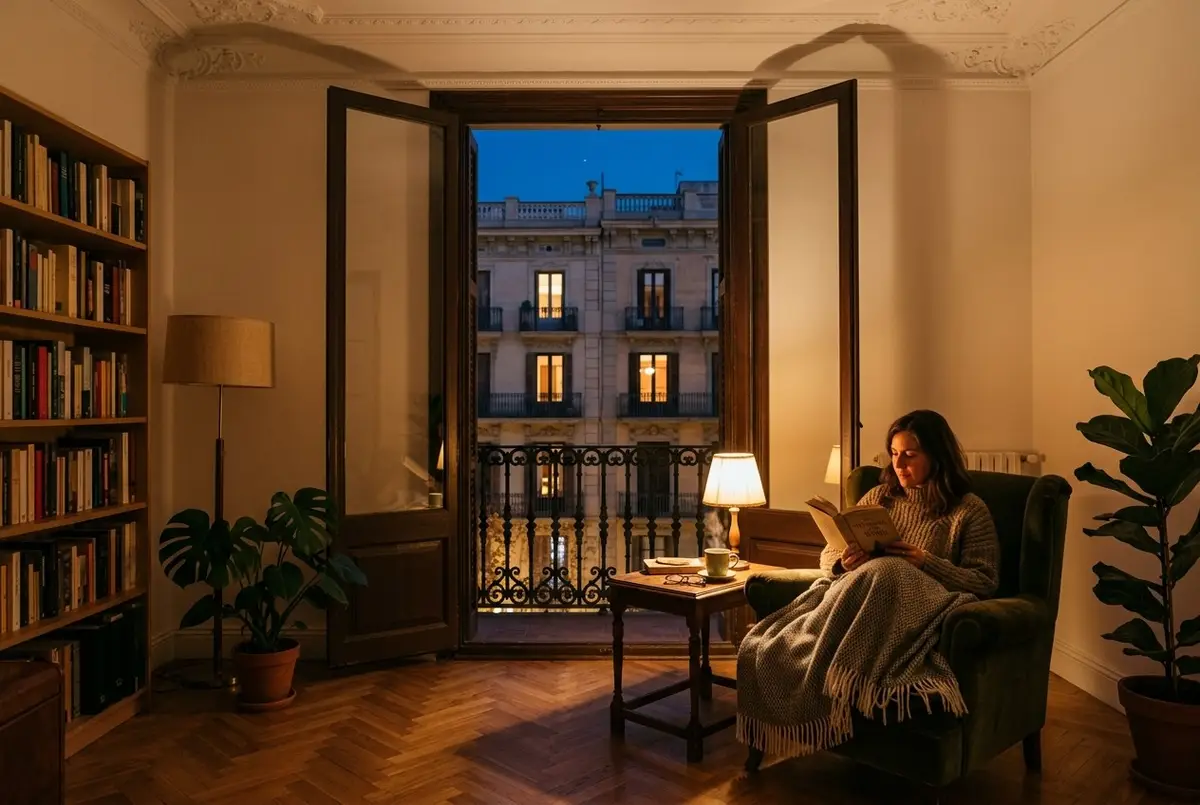
On Sunday 25 October the clocks go back and, overnight, it gets dark in Barcelona before six. From then on, almost the whole evening at home is spent under artificial light. And in most homes that light is the same at all hours: the same white and the same brightness for breakfast at eight as for reading on the sofa at eleven at night.
For seeing, it makes no difference. For your body, it's another story: as well as for seeing, the eye uses light as a clock, and a home that's still lit at midnight as if it were midday is telling it the wrong time. Circadian lighting is about giving the light in your home the same rhythm as the light outside.
What circadian lighting is
It means adjusting two things about light over the course of the day: how much there is and what shade of white it is. In the morning and during the day, plenty of light in a neutral or cool white, like the sky's; at dusk, less light and warmer; and before bed, just a little, amber-toned, like the glow of a table lamp.
The reason lies in the retina. Besides the cells we see with, the eye has others that play almost no part in vision and whose job is to tell the body's internal clock whether it's day or night; they're especially sensitive to bluish light. It's a field where the evidence keeps growing, but it's worth being clear from the outset: this isn't a treatment to help you sleep better, but a way of making sure the light in your home doesn't work against your body clock.
What the science recommends, in three figures
In 2022, PLOS Biology published consensus recommendations on indoor lighting for healthy adults, drawn up by an international group of light and sleep researchers. They boil down to three figures:
- During the day, at least 250 lux at eye level, ideally from daylight.
- In the three hours before bed, no more than 10 lux.
- For sleep, no more than 1 lux: the bedroom as dark as possible.
With one important caveat: these aren't ordinary lux but “melanopic” lux — in other words, light measured the way that internal clock perceives it. At the same brightness, a warm light counts for considerably less than a cool one, which is why the same paper notes that many warm-white household LED bulbs, from 2,700 to 3,000 K, already have a suitable spectrum for the evening. What almost nobody does is the other half: turning the brightness down as the night goes on. A living room with all the ceiling lights on at eleven o'clock, even warm ones, is still a lot of light.
What the kelvin numbers mean
The shade of white a light gives off is measured in kelvin (K): the lower the number, the warmer and more orange the light; the higher, the cooler and bluer. For reference:
- Around 1,900 K: a candle flame.
- 2,200–2,700 K: warm, like the classic old-fashioned bulb. For the last hours of the day.
- 3,000 K: warm but crisper. For dusk.
- 4,000 K: neutral, typical of an office. For working hours.
- 5,000–6,500 K: cool, similar to an overcast day. For the morning.
For the same light to shift from one white to another, it needs the electronics built in: a smart bulb or a tunable-white light fitting. A module behind the switch can turn on, turn off and dim what you already have, but it can't make an ordinary bulb warm at night and neutral in the morning. And watch out for another common mix-up: a bulb that changes colour isn't guaranteed to produce good warm and cool whites. What matters here is the range of whites, not the rainbow.
A day of light at home, hour by hour
Here's how all of the above plays out in an ordinary home, from morning to night.
When you wake up
A gentle start is always welcome: in the bedroom, the light rises gradually in a warm tone, without the blast of white light at seven o'clock. But once you're up, the morning calls for the opposite. Daylight is best: blinds or shutters that open by themselves when you wake up do more for your body clock than any bulb. In the depths of winter, when the sun doesn't rise in Barcelona until after eight, the kitchen and bathroom lights come on in a neutral or cool white, nice and bright: it's the signal that the day has begun.
During the day
If you work from home, a desk by the window is the best lamp there is. When daylight can't reach you — short winter afternoons, a flat facing an inner courtyard — what you want is a neutral white, around 4,000 K, with enough brightness on the desk.
At dusk
Sunset marks the start of the transition: the light drops to around 3,000 K and gradually loses brightness. It also helps to change where the light comes from: less of the ceiling light and more lamps at mid-height, which light what's needed without flooding the room.
The three hours before bed
This is when the difference is most noticeable, and the time almost nobody pays attention to: the house is still lit as it was at dinnertime. What's called for is warm light — 2,200 to 2,700 K — at the lowest level that's still comfortable for reading, tidying up or chatting.
In the middle of the night
If someone gets up, the hallway and bathroom lights come on by themselves, at their lowest and warm: just enough not to trip over anything. How to do this without the sensor being a nuisance is covered in our article on lights that turn on by themselves and presence sensors.
Let the house do it by itself
Doing all this by hand won't last a week. The whole point is for the house to do it: the system knows the actual times of sunrise and sunset each day — including on the day the clocks change — and adjusts both the white and the brightness of each room at the same time, without anyone lifting a finger.
- Each room on its own schedule. The children's bedroom starts dimming earlier than the living room; the study stays neutral for as long as someone's working in it.
- The switch has the final say. If someone wants more light, they get it; the rhythm picks up again by itself later.
- Scenes put it on hold. A dinner with guests or a film doesn't have to keep time with the clock: the scene takes over for as long as it's on.
- No building work. Tunable-white bulbs or fittings where you want to change the tone, and wireless modules (Zigbee, Z-Wave or Wi-Fi) behind your existing switches to dim the rest. Your usual switches keep working.
What lighting doesn't do
It's best not to sell it as something it isn't. It's not a sleep treatment: if you regularly sleep badly, the person to see is your doctor, not your installer. Light is one piece among several — bedroom temperature is another, and we cover it in our guide to what temperature to set in each room — and there are two that the house doesn't control: the daylight you get during the day, which no bulb can replace, and screens. A phone a hand's breadth from your face is light too, and no home automation system is going to switch it off for you.
How much it costs
It depends mainly on how many lights need to change their white. A typical smart lighting installation costs from €600: scenes, schedules and presence detection in the main rooms of a flat. On top of that, what you add is tunable white where it really makes a difference — living room, bedroom, kitchen and bathroom — and during the visit we look at which lamps are worth replacing and which can stay as they are. You'll find the details of what's included on our smart lighting page.
Common questions
What colour temperature is best for sleep?
In the hours before bed, a warm light — between 2,200 and 2,700 K — and, above all, not much of it: enough to read or tidy up comfortably, not the whole living room lit up. And for sleep, none at all: keep the bedroom as dark as possible. If you need a light to find your way in the middle of the night, make it minimal and warm.
Do “circadian” bulbs work on their own?
Only halfway. A tunable-white bulb can go from warm to cool, but it doesn't know what time it is: if nobody tells it when to change, it stays on whatever white it had. What turns a bulb into circadian lighting is the system controlling it, which follows the actual times of sunrise and sunset and adjusts both the tone and the brightness of each room at once.
Do I have to replace every lamp in the house?
No. The sensible approach is to start where you'll notice it most: the living room and bedroom in the evening, and the kitchen and bathroom in the morning. Everywhere else, a module behind the switch already lets you dim the light, which is half the job; only bulbs and fittings with the electronics built in can change their white. During the visit we look at what's worth replacing and what can stay as it is.
What about the light from phones, tablets and the TV?
It counts too: it's light that goes straight into your eyes from close range. Your home can dim and warm the light in each room, but it can't control anyone's phone. That's what the devices' own night mode is for — and, above all, the habit of putting them down for a while before bed.
Can I switch it off for a dinner or a film?
Yes. The circadian rhythm is the default behaviour, not an obligation: a “dinner” or “cinema” scene suspends it in that room for as long as it's on, and the wall switch always has the final say. When it ends, the light goes back by itself to whatever suits that time of day.
In short
The light in your home doesn't have to be the same at eight in the morning as at eleven at night. Bright and plentiful during the day — ideally sunlight — warm and increasingly dim in the evening, and darkness for sleep: that's what sleep researchers recommend, and what a home can do by itself by following the actual time of sunset every day. With the clocks about to go back and the winter evenings ahead, now's a good time for the light in your home to get back in step with the day.