
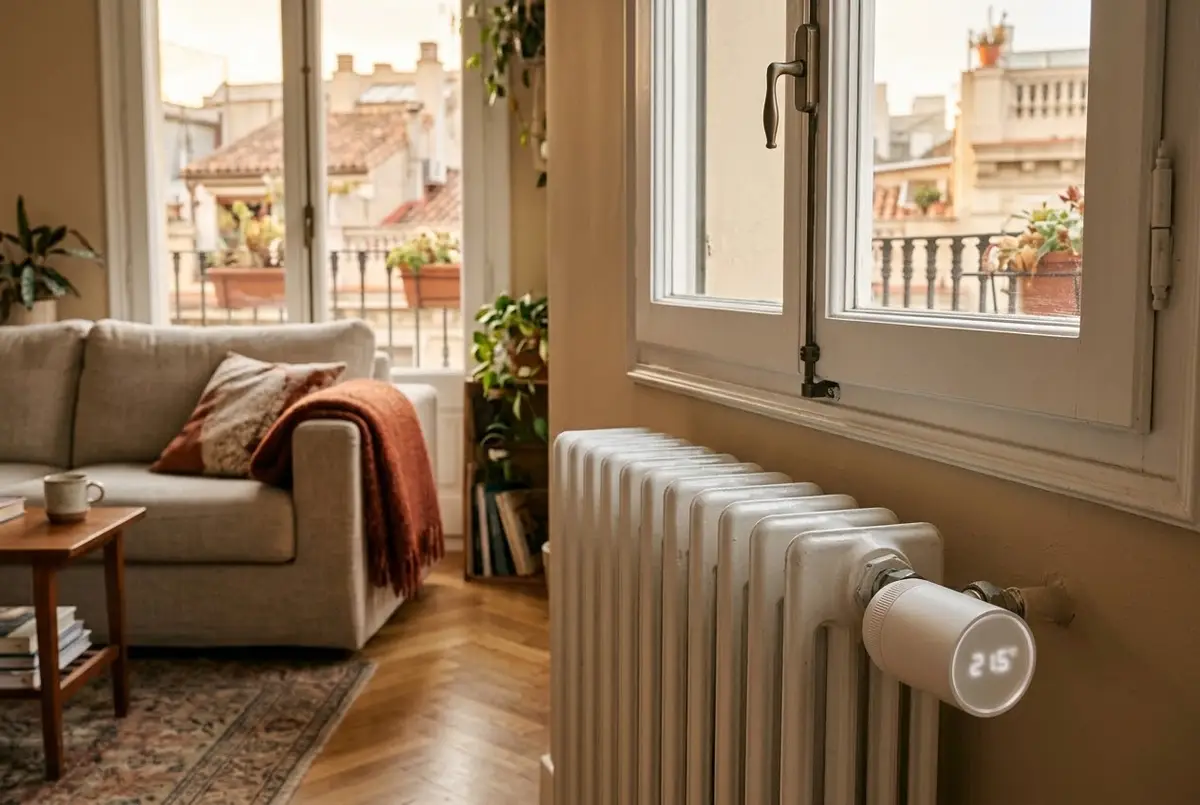
The first properly cold day always arrives the same way. One morning in late October you get up, notice the house is at fourteen degrees and head to the hallway to turn up the thermostat, which has sat on the same setting since March. The whole home starts to warm up: the living room, the three bedrooms, the bathroom, the entrance hall and that room with nothing in it but a bike and the big suitcase. All at once and all to the same temperature, because that's how it works.
And that's where the problem lies — and it has nothing to do with gadgets or the boiler: nobody lives in a whole home at once. The living room is used from seven in the evening until midnight, the bedroom is used for sleeping — which is exactly when you want the least heat — the bathroom needs a good fifteen minutes in the morning and the bike room needs nothing at all. Splitting the heat by room and by time of day is the biggest lever there is in heating, and it doesn't involve changing the boiler. This is the guide to what to set where.
The hallway thermostat measures where you don't live
Almost every flat has a single thermostat, and it's almost always in the worst possible spot: the hallway or the entrance hall. It's a narrow space with no window, often without a radiator of its own, with the front door opening and closing and the air from the whole home passing through. That one spot decides whether the boiler starts or stops for every other room.
Anyone who has lived in a flat with radiators knows the result. The hallway reaches 21 °C quickly because it's small, the boiler switches off, and the bedroom overlooking the inner courtyard — the one with the cold wall and the old window — stays at 17 °C all night. Or the other way round: to get the bedroom comfortable you have to set the thermostat to 23, and then the living room, which faces south and gets sun all afternoon, climbs to 24 and you end up opening the balcony door in the middle of December. Either way, you're paying for gas to end up uncomfortable.
The solution isn't a better thermostat in the same spot. It's to stop having just one spot.
Every room wants its own temperature
In its energy-saving advice for households (in Spanish), the IDAE — Spain's national energy agency — recommends between 19 and 21 °C during the day and between 15 and 17 °C at night for a home, and calculates that each extra degree adds around 7% to consumption. Those are averages for the whole home; the interesting part is bringing them down to each room, because that's where the advice becomes something you can act on.
The living room: 19–21 °C, and only when it's in use. It's the room where you sit still — on the sofa, reading, watching something — so it's where you feel the cold most. It deserves the top of the range. What it doesn't deserve is to be at 21 °C from nine in the morning: having it start mid-afternoon so it's warm by seven is all it takes. And if it has a south-facing balcony, on some winter days in Barcelona you won't even need to switch it on.
The bedroom: cooler at night, warm when you wake up. It's the change that surprises people most and the one that saves the most. You sleep better at 16–18 °C than at 21, and that's eight hours in a row: turning it down there means turning it down for the longest stretch of the day. The clever part is the other half of the rule — the valve opens half an hour before the alarm goes off, so getting up doesn't mean stepping out into a freezing room. Cool for sleeping, warm for getting up; until now you had to choose.
The bathroom: a short boost in the morning. It's the only room in the home where going above the recommendation makes sense, because you're wet and standing still. A couple of degrees above the rest for the twenty or thirty minutes around your shower, and the minimum for the rest of the day. A short boost costs very little; a bathroom at 23 °C all day costs a lot.
The kitchen: one or two degrees lower. It heats itself. The oven, the hob, the fridge and people moving about on their feet give off plenty of heat, and it's usually the room that gets aired the most. Setting it to the same level as the living room is one of the biggest sources of surplus heat in a flat.
The room nobody uses: at the minimum — but not off. Turning the radiator off completely and shutting the door behind you is a classic, and it isn't a good idea: a cold, unventilated room in a humid city like Barcelona ends up with condensation on the glass and mould on the wall behind the wardrobe. Keeping it at around 15 °C prevents that, means less heat escapes through the walls it shares with the neighbouring rooms, and costs a fraction of keeping it in use.
None of this has to be right first time. The usual approach is to set some starting temperatures on installation day and adjust them over the first two or three weeks of cold weather, which is when everyone discovers what they really like.
The time matters as much as the temperature
A radiator doesn't heat a room in five minutes: between the water warming up and the air in the room catching up, it can take anything from half an hour to well over an hour, depending on how big the room is and how cold it has got. That inertia is why turning up the thermostat when you get home is a bad plan — and also why splitting the heating by time of day works so well.
Heat ahead, don't play catch-up. If you want the living room at 20 °C at seven, the command has to go out at quarter past six. Done that way, you come home to a house that's already comfortable; done the other way round, you spend the first hour with your coat on and the boiler flat out, which is exactly when it uses the most.
Turning up the setting doesn't heat any faster. It's the most widespread misunderstanding about heating. Setting the thermostat to 25 doesn't make the water arrive any sooner or any hotter: the boiler is already giving all it can. All it achieves is that, once the room reaches 21, it keeps heating up to 25 — and that you forget to turn it back down. You pay for every extra degree, and according to the IDAE each one costs around 7%.
Weekends aren't weekdays. A schedule that works from Monday to Friday makes little sense on a Saturday, when the house is occupied from mid-morning. Having two programmes, and a system that knows what day it is, avoids the cold Saturday at eleven and the Tuesday with the heating on for nobody.
Stop heating the street
Once the rooms are split up, there are two situations worth tackling separately, because they're pure waste.
The open window. You air the room for ten minutes in the morning and, meanwhile, that room's radiator is working flat out, fighting the air from the street. A small sensor on the window — or simply the sudden drop in temperature, if you'd rather not fit anything — makes that radiator, and only that one, stop for as long as the window is open and start again on its own when you close it. There's nothing to remember.
The empty home. Between the last person leaving in the morning and the first one coming back in the afternoon, there are many hours of heating for nobody. It isn't about switching everything off — reheating a cold home costs more than keeping it warm — but about dropping a few degrees during that stretch and starting to warm back up before anyone arrives. If the system knows nobody has gone out that day, it doesn't turn down.
You're still in control
This is the rule that makes everything else acceptable to the whole family: the schedule proposes, the person decides. The valve can be turned by hand just like the old one, and if someone feels cold in the living room on a Sunday afternoon, they turn it up and it stays up until the next time slot. Nobody has to get their phone out to be warm, and nobody has to ask an app for permission. The house takes care of ninety per cent of the time — the repetitive part; the rest is up to you.
It's the same principle behind every smart home installation we design: automate what repeats, and never take away anyone's usual way of doing things.
What you need and what it costs
Less than you might think. A smart valve on each radiator you want to control, a thermostat or relay in the spot where the boiler thermostat is today, and a small device that coordinates the schedules inside your home. No building work, no touching the plumbing and no changing the boiler; if you want the details of how the piece that controls the boiler works, we explain it in our guide to the smart thermostat for heating.
A smart climate control installation like the one in this guide starts from €700, as a one-off payment with no monthly fees, and the number of radiators is what moves the figure most — which is why, during the visit, we look at which ones are worth it and which aren't. It comes with the same warranty as everything else we install: we guarantee our installation and configuration for 5 years. The devices carry their manufacturer's warranty (2–3 years), and we handle it for you.
If your heating is electric rather than gas, splitting it by room also shows up on your electricity bill, and then it's worth looking at two things together: how much each appliance uses and what time of day it's best for it to run. We explain that in our guide on how to monitor your home's electricity consumption.
Common questions
Do I have to change my boiler or radiators?
No. Splitting the heat by room doesn't touch the boiler or the plumbing: the control on each radiator — that plastic dial numbered 1 to 5 — is swapped for a head that does the same job but follows a schedule and a sensor. It screws on in the same place, runs on batteries and takes a few minutes per radiator. The boiler is still yours and gets told the same thing as before: whether heat is needed or not.
Does it keep working if the internet goes down?
Yes, and it's a difference worth asking about before you buy anything. In a well-designed installation, the schedules and temperatures live on a small device inside your home, not on a brand's server: the bedroom warms up at seven in the morning even if your fibre connection is down, and even if that company shuts down the service three years from now. You only need the internet to check or change things from outside the house.
What if I have underfloor heating or an air-source heat pump instead of radiators?
It can be split into zones too, although the splitting happens somewhere else: instead of a head on each radiator, actuators on the manifold open or close each circuit. What really changes is the pace. Underfloor heating and heat pumps have a lot of inertia — they're slow to warm up and slow to cool down — so they work worse with constant switching on and off and much better with gentle curves and anticipation. In other words: time-based scheduling pays off even more there than with radiators, but it has to be done with more lead time.
How many radiators do I need to zone for it to be worth it?
You don't need to do the whole home in one go, and it's almost never what we recommend. Just starting with the rooms whose schedules are very different from each other — bedrooms and living room — already makes a noticeable difference, because that's where most heat was being given away. Rooms you only pass through, or ones nobody uses, can wait for a second round, or be dealt with simply by leaving them at the minimum. During the visit we look at how many radiators there are and which ones are genuinely worth it; sometimes it's four out of nine.
In short
Most flats heat an entire home to live in two rooms, and they decide it from a hallway. Splitting the heat — the living room at 20 °C in the evening, the bedroom cool at night and warm when you wake, the bathroom with its short boost, the empty room at just enough to keep mould away — is one of the few things that improves comfort and lowers the bill at the same time, and you don't need to change anything you already have. Stop heating rooms; heat hours and people.