
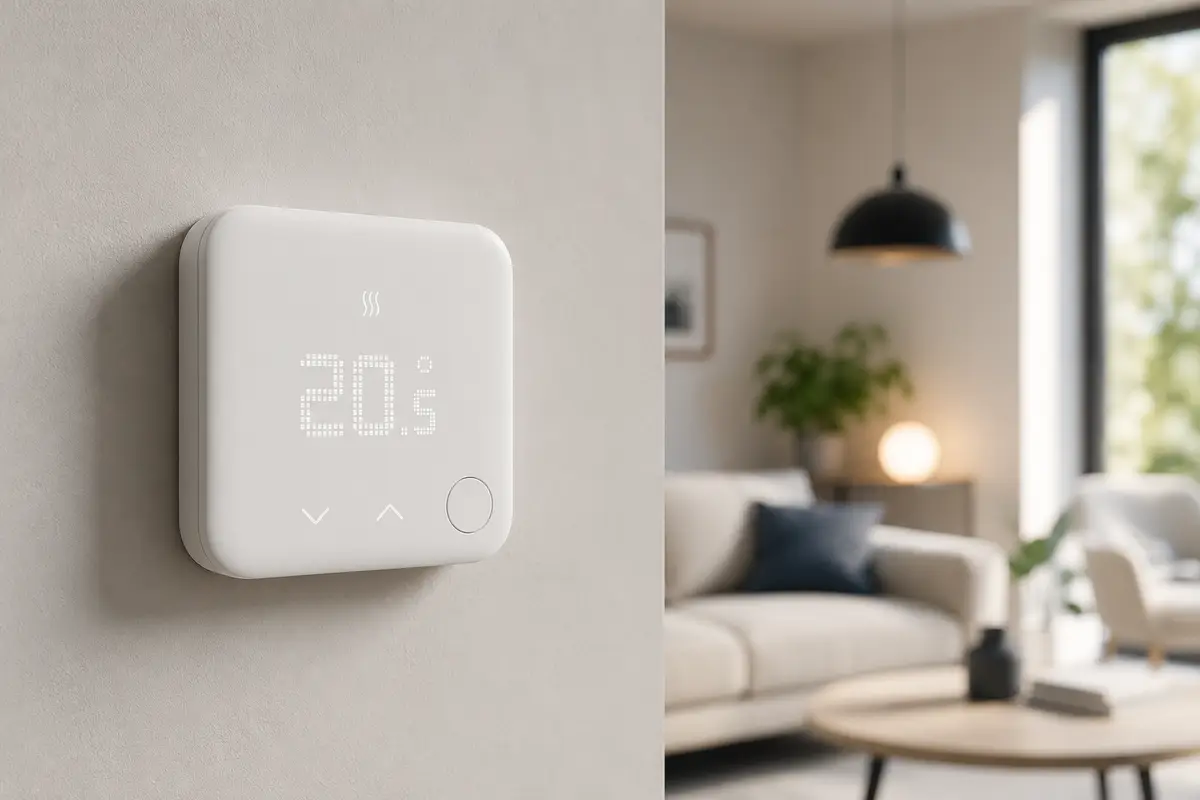
A traditional thermostat is, at heart, a switch with a thermometer attached: it turns the boiler on when the temperature drops below a threshold and off again once it goes above it. It doesn't care whether anyone is home, whether the midday sun is already warming the living room or whether you're only using two of your five rooms. A smart thermostat turns that blind decision into real management: it takes schedules, presence and what's happening in each room into account.
In this guide we explain how it works on the most common set-up in Barcelona — a gas boiler and radiators — which specific mechanisms deliver the savings, what they can add up to in a real flat, and how to set it up so it runs locally, without depending on any manufacturer's cloud. Properly configured, it's one of the key pieces for cutting heating and cooling consumption by up to 30% without giving up comfort.
So why talk about heating in the middle of summer? Because it's the best time to get it ready: the work gets done with no rush and no cold, the schedules and zones are configured calmly, and when the first cold snap arrives the system already knows your routine. Leaving it until November means starting to save two months late.
What a smart thermostat is (and isn't)
It's worth separating three levels that are often sold under the same name. A manual thermostat holds a single fixed temperature. A programmable thermostat adds scheduled time slots: it's an improvement, but it still heats the living room at 10:00 even if nobody's home that Tuesday. And a smart thermostat adds what really makes the difference:
- Presence detection: it knows whether anyone is home (from your phone's location or from sensors) and stops heating the place when it's empty.
- Sensors in each room: it measures the temperature where you actually live, not just in the hallway where the thermostat happens to be.
- Zoning: each room can have its own target temperature and its own schedule.
- Integration with the rest of your smart home: it reacts to open windows, the weather forecast or the position of the blinds.
One warning, though: a thermostat “with an app” that just flips the same old switch from your phone isn't smart — it's a remote control. The intelligence lies in it making decisions on its own, without you having to keep an eye on it.
How it cuts your heating bill (gas boiler and radiators)
The savings don't come from a single trick but from four mechanisms that add up:
1. Schedules and presence: don't heat an empty home
It's the most common waste of all: the heating left on “just in case” while everyone is out. With presence detection, the system automatically lowers the target temperature when the home empties and preheats it before you arrive — using your phone's location or your usual schedule — so you never feel cold or pay to heat empty chairs.
2. Zoning: a smart valve on every radiator
In a flat with radiators, the most powerful way to save is to stop treating the whole home as a single zone. Smart thermostatic radiator valves (TRVs) — Zigbee or Z-Wave, battery-powered — replace the manual valve on each radiator in minutes and let every room have its own temperature and schedule: the bedroom doesn't need 21 °C at 11 in the morning, and nor does the living room in the small hours. Only what's in use gets heated, and only while it's in use.
3. The right temperature (and what each extra degree costs)
According to the IDAE, Spain's national energy agency (in Spanish), 21 °C with suitable clothing is enough to keep a home comfortable, and each degree of difference accounts for around 7% of consumption for heating and cooling. The same body estimates that thermostatic valves and programmable thermostats save between 8% and 13% of energy on their own. A smart thermostat holds the exact target temperature without swings and puts an end to the classic “I'll turn it up to 24 so it warms up faster” — which doesn't warm up any faster: it just heats for longer.
4. Working with sensors and the weather
This is where the thermostat stops being a standalone device and becomes part of a system: if a sensor detects a window left open for more than five minutes, that room's radiator shuts off by itself; if the forecast promises a sunny afternoon, the system holds back because it knows the sun will do part of the work; and the actual outdoor temperature fine-tunes how early to start preheating in the morning.
How much you can save: an example in a Barcelona flat
Take a flat of around 80 m² in Barcelona with a gas boiler and heating costs of about €500 per season. Being conservative with each mechanism:
- Well-tuned presence detection and schedules: 10–15% in homes with changing routines.
- Per-radiator zoning: another 10–15% from no longer heating empty rooms.
- The right target temperature: around 7% for each degree corrected, according to the IDAE.
- Windows and weather: an extra 5% in flats that get plenty of sun.
In a home that was already managed carefully, a 15–25% saving (€75–125 per season) is a realistic result; if you're starting from haphazard use — heating on all day, the whole home at the same temperature — the results come close to our maximum of up to 30% on heating and cooling. Because the investment in valves, thermostat and integration is modest, the savings pay it back winter after winter, and on top of that every room is at the right temperature.
Local or cloud: thermostats that work without the internet
Most off-the-shelf smart thermostats depend on the manufacturer's cloud: the command you give in the app travels to their servers and back to your boiler. If their service goes down, changes its terms or introduces a fee, your heating feels it — and your data on when you're home and how you live leaves the house.
Our approach is the opposite: Zigbee or Z-Wave TRVs coordinated by Home Assistant, the open-source home automation platform, with all the logic running inside your home. Even well-known brands such as Tado or Netatmo can now be integrated locally via Matter/Thread, without going through their servers. The result: your heating keeps working even if the internet goes down, you don't pay subscriptions for basic features, and your data stays at home. If this matters to you, we have a full guide to cloud-free home automation.
Compatibility: will it work with my boiler and radiators?
It's the most common question, and the answer is usually yes:
- Gas boiler with an on/off (contact) thermostat: the most common case. A smart relay takes the place of your current thermostat and the boiler doesn't even notice the change: practically any boiler with a thermostat input will do.
- Boilers with OpenTherm: if your boiler supports this protocol, the controller can also modulate its output (not just switch it on and off), for gentler start-ups and a little extra efficiency.
- Radiators: if they have a thermostatic valve, the smart head screws on in its place in minutes; if it's an old manual valve, the valve body is replaced — a minor plumbing job.
And if your heating doesn't run on a gas boiler? It can be automated too: electric radiators and storage heaters are controlled with smart relays or plugs that measure consumption; and with air-source heat pumps or underfloor heating, smart control manages target temperatures and zones just as described here — the difference being that these are slow-to-respond systems, where good advance scheduling saves even more than with radiators.
A visit pins down exactly what your installation needs; you can see the details of our smart heating and air conditioning solution.
Conclusion
A smart thermostat isn't a gadget: it's the move from “turning the heating on” to managing it — heating only what you use, when you use it, at the right temperature, with a system that runs locally, with no monthly fees and no dependencies. And the same foundation works all year round: in summer, that very system is what coordinates the air conditioning to save on cooling. If you'd like to know what your home would need, at 2SmartHome we'll look at it with you, based on your actual installation.