
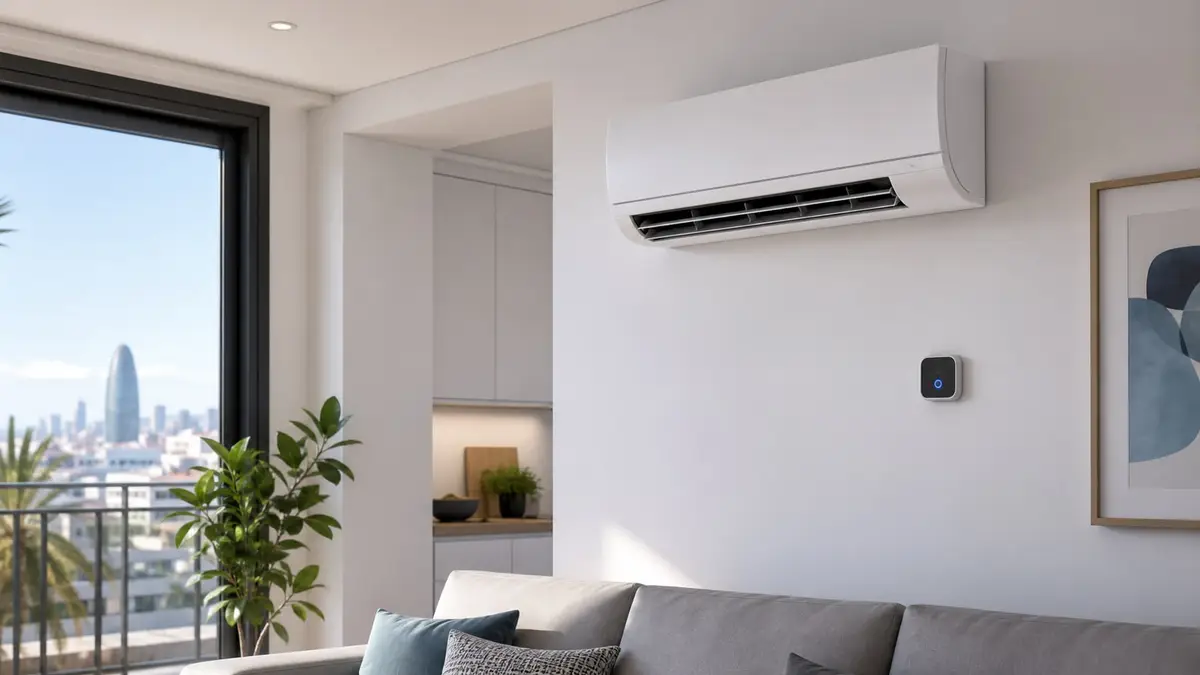
Summer in Barcelona is, along with winter, the time of year when electricity bills shoot up. Saving on air conditioning in Barcelona with smart controls isn't just a marketing promise: with well-configured automations, an average family can cut the energy it uses for climate control by up to 30% without giving up comfort.
In this article we use real data on Barcelona's climate and typical energy use to work out how much you can save and which automations make it possible.
How much an average family spends on air conditioning in Barcelona
According to figures from the ICAEN, the Catalan Energy Institute (in Catalan), an average Catalan home uses between 1,200 and 1,800 kWh a year on heating and cooling, with a clear peak in July and August. In an 80–90 m² flat in Barcelona with two or three split units, the cost of summer air conditioning can easily top €180–250 over three months.
Most of that consumption comes down to three inefficient habits that home automation can eliminate:
- AC running with nobody home: forgetting to switch it off when you go out is more common than you'd think. A 2.5 kW split unit running 4 extra hours a day adds 10 kWh, or about €2 a day at the average 2026 price on Spain's regulated PVPC tariff.
- Poorly set temperature: a 1 °C difference on the thermostat can mean a 6–8% difference in consumption. Many households keep the AC at 21 °C when 24 °C would be perfectly comfortable.
- Unmanaged heat gain: afternoon sun coming in through the window can push the indoor temperature up by 3–5 °C, forcing the AC to work twice as hard. Coordinating your blinds with the AC is one of the improvements with the biggest impact.
Key automations for saving on climate control
Presence-based control
This is the automation with the biggest financial return. With Home Assistant and a presence sensor (or by detecting your phone on the local network), the air conditioning switches off when nobody's home and comes back on 15–20 minutes before you arrive, so the temperature is just right.
In a Barcelona summer, when flats heat up quickly but also cool down quickly with the AC, this automation alone can save between 15% and 25% compared with leaving it on all day.
Coordinating blinds and air conditioning
This combination is what sets complete smart home systems apart. The system knows which façades get the sun at each hour of the day and automatically lowers the blinds on those windows before the heat gets in. As a result, the AC has to work less to hold the temperature.
A simulation for a typical flat in Barcelona's Eixample (south-south-west facing, 90 m²) shows that coordinating blinds and AC can reduce heat gain by 30–35% during the hottest hours of the day (14:00–19:00). That cut is concentrated in the sunniest hours, so it weighs less on the bill: you'll see it in euros in the calculation below.
Scheduling around time-of-day prices (PVPC)
The PVPC tariff (Precio Voluntario para el Pequeño Consumidor, Spain's regulated electricity rate) changes by the hour, and in summer electricity can cost 3 to 5 times more at peak hours (9:00–22:00) than at off-peak hours (overnight). With home automation, you can pre-cool the house early in the morning (when electricity is cheap) and run the AC less at peak hours, relying on thermal inertia. The same logic works for the rest of the house: in our guide to monitoring your electricity use and making the most of off-peak hours we explain how to shift the washing machine, water heater and car to the cheap hours.
This strategy needs the flat to have some thermal mass (thick walls, tiled floors), which is common in Barcelona's older buildings, and it can save an extra 10–15% on the bill.
Adaptive temperature based on occupancy
The system can automatically adjust the temperature depending on which rooms are occupied. There's no point cooling the whole flat if you're only in the living room. With presence sensors in each room and individual split units, consumption is optimised room by room.
Calculating the real savings in Barcelona
Taking as a reference an 85 m² flat in the Eixample with 2 split units (living room and main bedroom), a typical summer cost of €220 (June–August), and applying the automations above:
- Presence-based control: −15% → −€33
- Blind coordination: −8% on the remaining consumption → −€15
- PVPC optimisation: a further −10% → −€17
Estimated total saving: €65 in one summer, almost 30% of what the air conditioning costs. A typical smart climate control installation starts from €700, so the summer savings alone would take almost eleven years to pay for it. But the same automations also cut your heating in winter, with an equal or greater saving, as we'll see below: counting the whole year, it pays for itself in about five.
Compatibility: will it work with my air conditioning?
The good news is that Home Assistant can control practically any modern air conditioner. The most common options are:
- Split units with built-in Wi-Fi (Daikin, Mitsubishi, LG, Fujitsu, Samsung, etc.): direct integration through the official Home Assistant integration or modules such as Wibeee or ESPHome.
- Split units without Wi-Fi: an IR module (such as a Broadlink RM Mini 3 or Sensibo) is added to mimic the infrared remote control. This covers almost every model on the market.
- Older split units (pre-2015): also compatible with the IR module, as long as they have a remote control.
Beyond summer: heating and flat-rate tariffs
The same automations that work for the AC in summer apply to the heating in winter. In Barcelona, where winters are mild but nights can be cold, a smart climate control system that switches the heating off when nobody's home and schedules it in advance for when you come back can deliver an equal or bigger saving on your bills from December to February.
All in all, a complete home energy management system in a Barcelona flat can cut total annual heating and cooling costs by up to 30%, with an investment that, counting summer and winter, pays for itself in about five years.
Conclusion
Automating your air conditioning is one of the smart home upgrades with the best return on investment in a Mediterranean climate like Barcelona's. Combining presence-based control, coordination with the blinds and optimisation of your electricity tariff can cut climate control costs by up to 30%, with an investment that pays for itself in about five years if you count both summer and winter.
At 2SmartHome we integrate climate control into complete smart home projects where the AC works in coordination with blinds, lighting and occupancy sensors. If you'd like a more precise calculation for your own case, we can carry out a no-obligation assessment.