
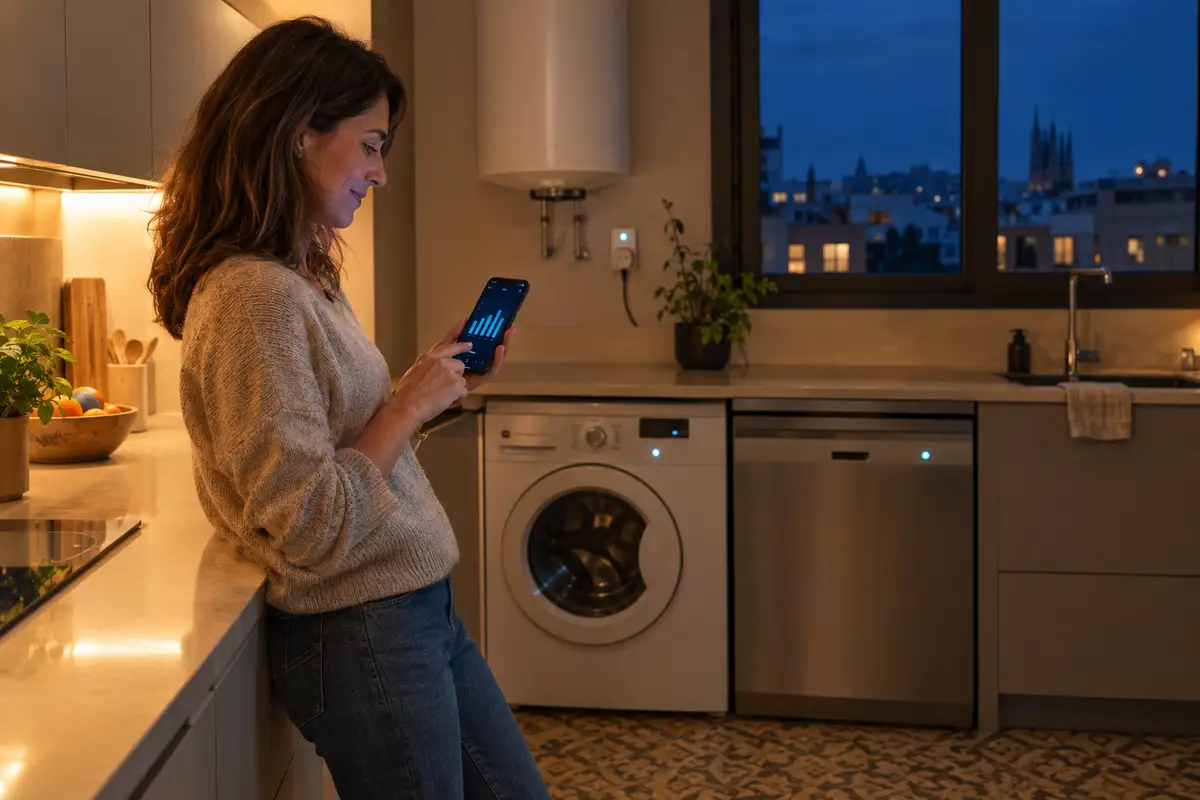
The October bill arrives and it's higher than August's. You haven't put the heating on, the air conditioning has been off for weeks and it's the same people at home. And yet the number has gone up. It's the same scene every autumn, and it almost always has the same explanation: your home is spending blind. You know what you pay each month, but not what on, or at what time, or which appliance is eating up a third of the bill while you're at the office.
This guide is about fixing that in two steps. First, measure properly: find out what each thing uses and when. Second, let the house shift whatever can be shifted — the washing machine, the water heater, the car — to the hours when electricity costs half as much. No building work, no switching supplier, and nobody in the family having to memorise a timetable.
Measure first, decide later
Trying to save electricity without measuring it is like trying to lose weight without scales: it can be done, but it's all guesswork. The bill gives you a single number a month; what you need is to see it hour by hour and appliance by appliance. There are two ways to get there, and most homes combine them.
A meter in the fuse box. It's a clamp that fits around the main cable — without cutting anything or touching the wiring — and tells you how much the home is using right now and how much it has used every hour of every day. If you want more detail, clamps go on individual circuits: heating and cooling, kitchen, sockets, washing machine. With that, the app shows you a graph where suddenly everything makes sense: the curve that climbs at three in the afternoon is the water heater; the step at night is the air conditioning in a room that was left on.
A smart plug on the appliances that matter. It goes between the wall socket and the appliance, measures what passes through it and can also switch it on or off. It's the natural place for the washing machine, the dishwasher, the electric water heater, the tumble dryer or the dehumidifier: the handful of appliances that, between them, account for most of a household's bill.
What shows up in the first week usually comes as a surprise. An electric water heater heating water mid-afternoon, when nobody's going to shower until the evening. An old fridge using twice what its label says. Standby from TVs, consoles, chargers and routers that, added together, is like leaving a light bulb on twenty-four hours a day. None of these things shows up on the bill; all of them show up on the graph. It's the foundation of any home energy management: until you know where the electricity goes, every decision is a gamble.
Off-peak hours exist, and almost nobody uses them
Since 2021, Spain's household electricity tariff — the one almost everyone has, known as 2.0TD — has split the day into three bands with different prices. On weekdays, the peak band runs from 10:00 to 14:00 and from 18:00 to 22:00; the mid-peak band covers 8:00 to 10:00, 14:00 to 18:00 and 22:00 to midnight; and the off-peak band runs from midnight to 8:00. Saturdays, Sundays and national public holidays are off-peak around the clock. Spain's markets and competition regulator, the CNMC (in Spanish), runs an official comparison tool where you can see which offers use this structure and at what prices.
If you're also on the regulated market — the PVPC, which grid operator Red Eléctrica publishes (in Spanish) every day for the day ahead — the price changes not just by band but hour by hour, and the most expensive hour of the day can cost several times as much as the cheapest. The practical upshot is simple: the same kWh costs far less at seven in the morning or on a Saturday than on a Tuesday at eight in the evening.
The problem isn't that people don't know. It's that making the most of it by hand is unbearable: remembering that today's a public holiday, checking tomorrow's prices, going to put the dishwasher on at a specific time. Nobody keeps it up for more than two weeks. That's why most households with time-of-use pricing end up paying as if they didn't have it. This is where home automation comes in: not so that you watch the clock, but so that the house does it for you.
What the house can shift on its own
The idea is to separate two things that currently go together: preparing an appliance and starting it. You keep doing the first whenever it suits you; the system takes care of the second, because it knows your tariff, what day it is and how much electricity costs at any given moment.
Washing machine and dishwasher. You load them in the evening, as usual, and press start. The smart plug holds back the power and starts the cycle when the cheap window opens — first thing in the morning, so they're not running while everyone's asleep, or on Saturday, which is off-peak all day. By the time you get up, the dishwasher has finished and cost half as much. If your appliance has its own “delay start” function, you can use that too; the advantage of the plug is that it decides using the real calendar, public holidays included, and it measures as well.
The electric water heater. It's by far the appliance that benefits most. A storage water heater keeps water hot for hours, so there's no need for it to heat up mid-afternoon: you schedule it to do so off-peak, in the small hours or first thing in the morning, and the water is still hot for the evening shower. In many homes it's the single biggest difference on the whole bill, and it doesn't require changing a single habit.
The electric car. You plug it in when you get home and the house decides when it charges: always off-peak, or when the PVPC price drops below a threshold, or when there's surplus solar power. With a charger connected to the system, the charging is also balanced against whatever the rest of the house is using, so you don't go over your contracted power (the maximum kW on your supply contract). It's the case with the most small print of all, so it has its own guide: how to charge your electric car at home without increasing your contracted power, including in a shared building garage.
Electric radiators and storage heaters. If your heating is electric, storage heaters charge overnight by design; with the system, that charge is matched to the next day's temperature forecast. Ordinary radiators follow the same logic as any smart heating: they come on by room, by schedule and by presence, as we explain in our guide to the smart thermostat for heating, which is the next chapter in this story once November comes round.
And one rule we always apply: nothing that needs someone standing next to it gets automated. The oven, the hob, the iron or any appliance with an exposed heating element is never scheduled remotely, however cheap the electricity. What gets shifted is what's already designed to run on its own.
If you have solar panels (or will do)
With self-consumption, the logic flips: the cheap hours are no longer at night but whenever the sun is out. The surplus you export to the grid is paid at a fraction of what you pay for the electricity you buy, so every kWh you manage to use as it's produced is worth much more than one you export. The system knows your production in real time and concentrates the schedulable loads — water heater, washing machine, car, even the air conditioning or heat pump — into the hours when the panels are producing more than the house is using. If you don't have panels yet but you're thinking about them, setting up monitoring today will tell you, with real data, how much of your consumption happens during the day — which is exactly the number that decides whether an installation pays off.
Alerts that arrive before the bill does
Measuring continuously has a side effect that, in the long run, is worth as much as the savings: the house notices odd things before you do. Night-time consumption that rises for no reason and turns out to be the air conditioning left on in the study. A water heater that starts using twice as much because its element is furred up with limescale and will die next month. A freezer in the storage room that has stopped cooling. The system knows each appliance's normal pattern and, when something breaks from it, sends an alert to your phone — the same “find out before it becomes a problem” logic as a water leak sensor under the sink, but applied to your bill.
There's an important detail in all this: your consumption history tells the story of how you live. What time you get up, when you're out, how many days you spend away. That's not data to give away. That's why we set up monitoring so it's processed in your own home, on your own network, and the history stays in the little box next to your router instead of going up to the servers of a manufacturer that also charges you a fee to show it to you. It's the same philosophy as the rest of the cloud-free home automation we install: the app works just the same, and the data doesn't travel.
How much it costs and when it pays off
A typical energy management installation starts from €400: whole-home monitoring at the fuse box plus control of the big consumers with smart plugs and relays — the water heater, the washing machine, the dishwasher. Per-circuit metering inside the fuse box, the car charger or full solar integration are quoted during the visit, which is free and comes with no obligation. It's all a one-off payment, with no monthly fees for seeing your own data.
When it comes to savings, we'd rather be careful with our promises: it depends on your starting point and how much of your consumption can be shifted. What is true in almost every case is that the installation pays for itself through what stops being wasted — the water heater running mid-afternoon, the forgotten air conditioning, the wrong tariff — and that after a month of data you'll know whether your contract suits you, something almost nobody knows today. As with any smart home installation we carry out, we guarantee our installation and configuration for 5 years. The devices carry their manufacturer's warranty (2–3 years), and we handle it for you.
Common questions
Do I have to switch supplier or tariff for this to work?
No. The system works with the tariff you already have: it measures, schedules and optimises based on your current prices. What does happen is that, after a month of seeing your consumption hour by hour, you'll know for the first time whether your tariff suits you — how much you use at peak times, how much off-peak, whether your contracted power is too high or too low — and you'll be able to change it with the numbers in hand rather than taking whatever deal someone happens to phone you with. Switching supplier is free and doesn't interrupt your supply; it's switching without knowing what you use that ends up costing you.
I'm on a fixed price at all hours. Is this any use to me?
Yes, even though the off-peak part won't do anything for you while you keep that contract. What's just as valuable as ever is knowing where your electricity goes: the water heater heating water mid-afternoon, the appliance drawing power when it should be off, the standby that adds up to more than you'd think. On a fixed price, the savings come from using fewer kWh, not from using them more cheaply, and for that you need to measure first. And if the data shows that a good part of your consumption could happen at night or at weekends, a time-of-use tariff will pay off — and your home will already be set up to make the most of it.
Is it safe to leave the washing machine or dishwasher running at night?
Manufacturers and fire services advise against leaving appliances running with nobody at home, and the reason is sensible: if something goes wrong while the house is empty or asleep, nobody sees it. That's why we don't simply suggest “putting the washing machine on at three in the morning”. The off-peak window starts at midnight and runs until eight in the morning, and at weekends it lasts all day: scheduling the cycle for seven in the morning, when someone's already awake, or for Saturday afternoon, gets you the same price without that risk. And because the system measures what each plug is using, if an appliance strays from its usual pattern it sends an alert to your phone — something an old-fashioned timer can't do.
I'm renting. Can I install any of this?
Almost all of it. The smart plugs that measure and schedule the washing machine, water heater or dishwasher go into the wall socket and leave with you the day you move out, and the clamp that measures overall consumption fits in the fuse box without cutting or changing anything in the wiring. The only thing worth discussing with your landlord is the per-circuit meter inside the fuse box, and it's a short conversation because that doesn't leave a mark either. In our guide to home automation in a rented flat, we explain what you can install without asking and what's best agreed beforehand.
In short
The autumn bill goes up because the house spends without anyone watching. A clamp in the fuse box and a few plugs that measure will show you within a week where the electricity goes; from then on, the washing machine, dishwasher, water heater and car start on their own when a kWh costs half as much, without you having to remember what day or time it is. And if something starts using too much, you find out from your phone, not from the bill. Measure first, shift second, and let the house watch the clock. If you rent, almost all of this moves with you too: we cover it in our guide to home automation in a rented flat.