
A leak in a flat doesn't start with a bang. It starts with a washing machine hose that's been in place for eight years, on a Sunday morning, while you're out having breakfast. By the time you get back, the problem isn't yours any more: it's the ceiling of the neighbour downstairs. And from then on the conversation stops being about plumbing and turns into insurance claims, loss adjusters, the owners' association and three months of messages in the building's group chat.
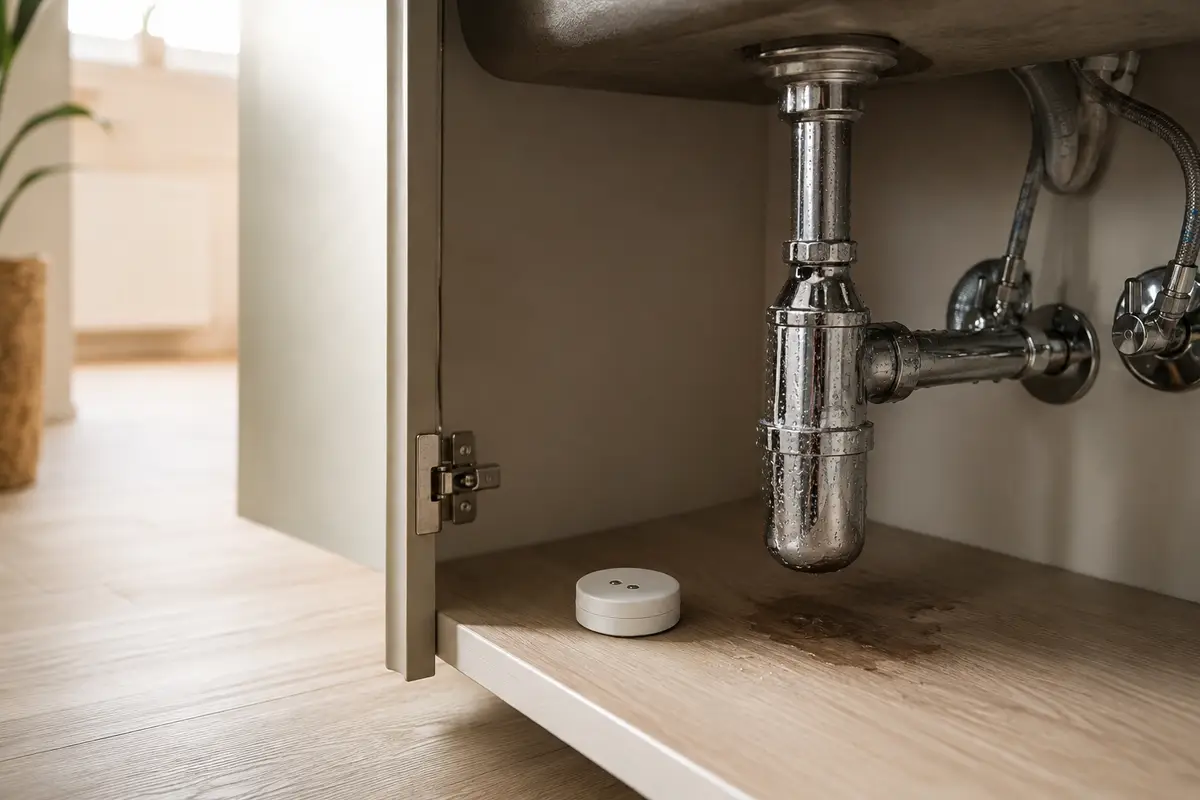
What's so out of proportion is the gap between what the disaster costs and what it costs to prevent it. A leak sensor is a biscuit-sized disc that you simply leave on the floor: no building work, no wiring and no touching the pipework. It doesn't fix the pipe — that's still a job for the plumber — but it turns “I found out three weeks later” into “I got an alert on my phone within ten seconds”. Which, when it comes to water damage, is practically the whole difference.
Water never stays in your own home
Year after year, water damage is the most common home insurance claim in Spain, far ahead of burglary, according to figures published by UNESPA (in Spanish), the Spanish insurance industry association. The explanation is decidedly unglamorous: for you to be burgled, someone has to turn up, but for a flexible hose to burst, all it takes is time.
And in a building, water behaves in the worst possible way: it goes down. A bucket of water on your kitchen floor is a job for the mop; the same bucket pouring down for twelve hours is the false ceiling of the flat below, its electrics and an argument about who's liable for what. That's why water sensors are one of the few things in a connected home that justify themselves: they're not a convenience, they're cheap insurance against the incident you're most likely to have.
The five places where it really starts
On our visits we always come across the same culprits. There's no need to scatter sensors all over the house: covering these points deals with the vast majority of what actually happens.
- Under the sink. The undisputed champion. It's the only spot in the home where a waste pipe, two angle valves, the tap's flexible hose and — often — the dishwasher connection all live together, packed into a closed cupboard that nobody opens except to get the bleach out. When it drips, it drips in the dark for weeks.
- Behind the washing machine. The rubber inlet hose is always under mains pressure, even when the machine is off. It's the failure that floods fastest, because it isn't a drip: it's the full flow of an open tap.
- The dishwasher. Same problem as the washing machine, with one aggravating factor: it's built in, so the water comes out from under the units and reaches the living-room parquet before anyone sees a drop.
- The water heater or boiler. Tanks give advance warning — a small damp patch at the base weeks before they fail — and that's exactly the warning nobody sees, because they're out on the utility balcony or up in a high cupboard.
- The bathroom doorway. Here the sensor isn't covering a pipe, it's covering overflow: a blocked drain, a shower screen that wasn't closed properly, a basin someone left running. It's the point where water escapes into the hallway.
How a water sensor works
There's no mystery inside, and that's a virtue: two metal contacts on the base, a few millimetres apart. As soon as a film of water bridges them, the circuit closes and the sensor triggers. There's no camera, no microphone and nothing to calibrate. It runs on a battery, is stuck down or simply placed on the floor, and installing it literally means leaving it in the right spot: no building work, no wiring and no touching the plumbing.
When it goes off, it does two things at once. A siren sounds in the home — which is what helps if you're inside, asleep — and an alert goes out to your phone and to whoever else you choose. The detail that separates a useful sensor from an ornament is the third thing: the low-battery warning. A detector with a flat battery doesn't fail noisily; it fails silently, and leaves you feeling reassured just when you shouldn't be. That's why we only install sensors that report their battery level to the system.
One point that matters more than it might seem: detection and the siren run locally, inside your home. If the router is down or the manufacturer is having a bad day, the sensor keeps detecting and the siren keeps sounding; the only thing that needs a connection is the notification to your phone. It's the same principle we follow with cloud-free home automation: the essentials can't depend on somebody else's server.
From alert to automatic shut-off
An alert is fine if there's someone who can do something about it. But if it reaches you on a plane, in a meeting or at four in the morning, all the sensor achieves is letting you know sooner about a disaster that's going to happen anyway. The next step up solves that: a motorised valve on the main stopcock. The sensor detects, the system gives the order and the water is shut off within seconds, with nobody having to step in.
It's the same device we recommend for the other situation where water is left on unsupervised — automatic watering while you're away on holiday — and here it solves the problem at the root. Fitting it takes two fairly ordinary things: being able to get to the stopcock, and having a socket nearby. When the stopcock is set into the wall behind a tiny access panel, or the only accessible one is on the landing and is therefore in a communal area, things get complicated, and sometimes you're better off sticking with the sensors. It's one of those decisions that can't be made from an article: you find out by opening the bathroom cabinet.
What a water sensor can't see
It's worth being clear here, because this is where most expectations fall apart. A sensor detects water on the floor. Full stop. What it doesn't detect:
- A pipe dripping inside a partition wall. The water stays in the wall and shows up months later as a stain, and by then the sensor on the floor hasn't noticed a thing.
- Rising damp in a ground-floor or semi-basement flat, which isn't a leak but a construction problem.
- Water seeping in from the flat above, which comes through the ceiling, not across the floor.
- A tiny, constant drip that evaporates before it can form a film. It's the one that wastes the most water over a year, and the one no contact detector is ever going to catch.
For those cases you need a different tool: a flow sensor on the main supply, which doesn't look for water on the floor but for water use that shouldn't be happening — such as water running for two hours straight at four in the morning. It's one step further and not every home needs it, but it's the honest answer when someone asks whether the sensors cover everything. They don't.
Three weeks away
If there's a time when this goes from advisable to obvious, it's August. The classic advice to turn off the stopcock when you go away is good, but hardly anyone follows it — and anyone with an irrigation system, a fridge with a water connection or a neighbour who comes round to water the plants simply can't. With sensors and a motorised valve you no longer have to choose: the water stays available for whatever needs it and shuts itself off the moment something breaks.
It's the same logic as the rest of holiday mode. Just as lights and blinds simulate someone being at home so the house doesn't look empty, the sensors take care of whatever might happen inside while nobody's there. And there's an important difference between the two risks: a burglary is unlikely, whereas the washing machine hose will fail on its own, given time.
How much it costs
Water sensors aren't sold as a standalone product: they're one more part of the installation, which is why the price depends on what they're being added to. If you already have a smart home system, adding them is one of the cheapest things you can do — they're paired, put in place and the alerts are set up in the same visit. If you're starting from scratch, they usually go into the security system, whose installation starts from €900 and includes the control panel, sensors, siren and configuration, with no monthly fees and no minimum contract.
The motorised valve is quoted separately, because its cost depends entirely on how your stopcock is set up. And as with everything else, the visit and the quote cost nothing: we come round, check the five risk points in your home and tell you how many sensors you really need. It's usually fewer than people imagine.
Common questions
Where do water leak sensors go?
On the floor, against the wall and as close as possible to whatever might fail: under the sink next to the trap, behind or beside the washing machine, next to the dishwasher, at the foot of the water heater or boiler and at the bathroom doorway. The rule is simple: wherever there's a hose, a seal or a drain, that's where a sensor goes. There's no need to fill the house with them — four or five spots cover practically everything that genuinely breaks in a flat. In a house with more floors, you add one in the boiler room and another in the utility room.
Will it alert me if I'm away from home?
Yes, that's exactly why you fit them. When the sensor detects water, the siren sounds at home and at the same time the notification reaches your phone, wherever you are, and the phones of whoever you choose: your partner, a relative or the neighbour with a spare key. Only the notification needs a connection; detection and the siren run locally and keep working even if the router is down.
Can it shut the water off automatically?
Yes, if you add a motorised valve to the main stopcock. The sensor detects, the system gives the order and the water is shut off within seconds, without anyone needing to be at home. Two things are needed: the stopcock has to be accessible and there has to be a socket reasonably close by. When the stopcock is set into the wall behind a tiny access panel, or in a communal area of the building, the installation gets complicated and sometimes isn't worth it; we check this on the visit before suggesting it.
How long does the sensor battery last?
Between one and two years, depending on the model and the temperature where it sits. What matters isn't the number but that the sensor warns you when the battery starts to run down: a silent detector is worse than none at all, because it gives you a sense of security that's no longer real. That's why we only install sensors that report their battery level to the system, and the low-battery warning reaches your phone just like a leak alert.
Does it detect a leak inside the wall?
No, and it's worth knowing that before you buy anything. A water sensor detects liquid water that reaches it — in other words, on the floor. A pipe dripping inside a partition wall, rising damp or a slow leak from the flat above won't be picked up until the water comes out and reaches the floor, if it ever does. For that kind of leak you need a different tool: a flow sensor that spots water use that shouldn't be happening, or simply an inspection with a thermal imaging camera.
In short
A leak sensor is the piece of home automation with the best ratio between how little it costs and how much it prevents. It doesn't repair anything and it can't see leaks inside walls, but it covers the five places where water damage really starts, and turns an incident costing thousands of euros into a phone alert and a bucket. If you can also get to the stopcock, the motorised valve closes the loop: the home defends itself even when nobody's there. And if you're going away for three weeks in August, that's exactly the difference between coming back to your home and coming back to an insurance claim.