
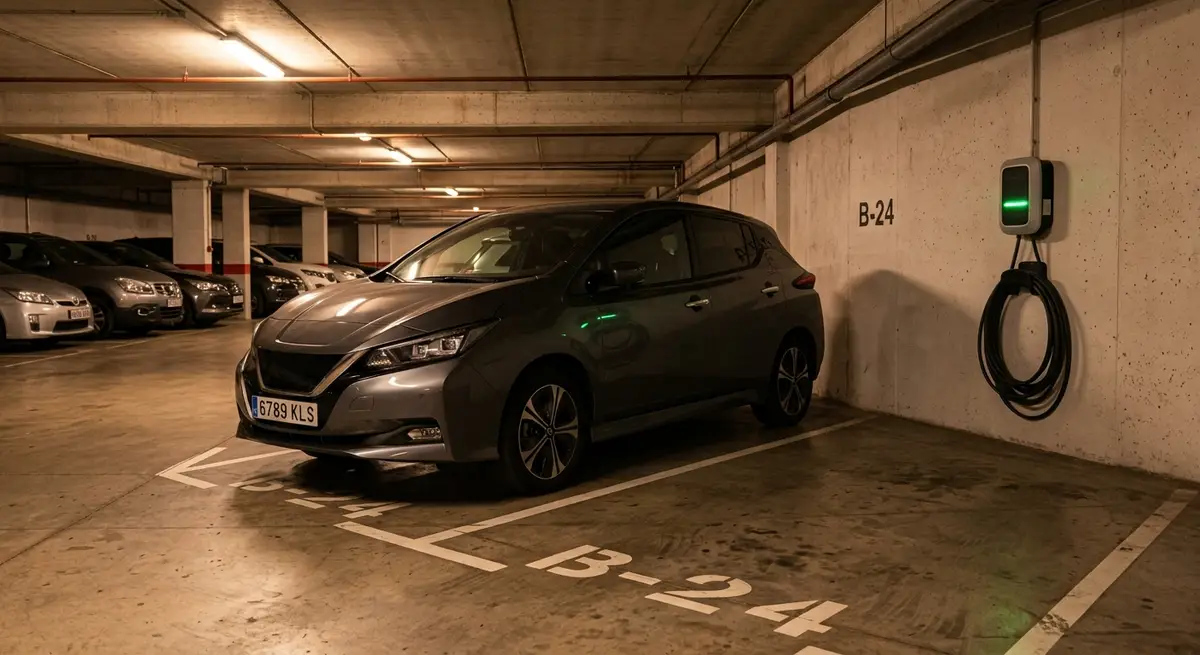
It's a scene that has been repeating itself in plenty of garages for a couple of years now. You get home at eight, plug the car in, go upstairs, and at nine — with the oven on, the hob at full blast and someone in the shower — the power goes off throughout the house. Nothing's broken: you've simply asked for more than you have contracted, and the switch that keeps an eye on that has done its job.
From there, almost everyone reaches the same wrong conclusion: you need to increase your contracted power (potencia contratada). It's the expensive way out, the one you pay for twelve months a year to solve a clash that lasts twenty minutes a day. There's another way — let the house share out what it already has, and let the car charge in the small hours, when a kWh costs half as much and isn't competing with anything. This is the guide to setting it up.
The problem isn't the socket, it's the power
A typical flat in the Barcelona metropolitan area has 3.45 or 5.75 kW of contracted power. A home charging point draws 3.7 kW if it's a basic one and 7.4 kW if it's one of the fast ones. The maths is easy: the car, on its own, can take all of the home's power. As long as nothing else is drawing power, all is well; the clash comes at dinner time, which is exactly when people plug the car in after getting home.
The three ways out you're usually offered are raising your contracted power, fitting a slower charger, or remembering to plug the car in yourself before you go to bed. The first pushes up the fixed part of your bill all year round. The second takes away speed on the days you really do need it. And the third works right up until the third Thursday you forget. None of the three tackles the real problem, which is one of sharing: the house and the car never need the maximum at the same time, but nobody has told them how to take turns.
Dynamic load management: the car gives way
The solution is simpler than it sounds and changes nothing in your installation. A meter is fitted in the fuse box — a clamp around the main cable, with nothing cut — that knows in real time how much the house is using. That reading goes to the charger, and the charger adjusts its rate accordingly, second by second.
In practice it looks like this: at nine in the evening, with the oven and hob on, the car drops to a trickle or stops. At eleven, when the kitchen is switched off and the house is using what a sleeping house uses, it goes up to full and takes all the spare power. Nobody has had to decide anything and the power hasn't tripped once. It's exactly the same clamp and the same logic used to monitor your home's electricity consumption: measure first, then share out.
This is what makes increasing your contracted power pointless in most cases. You don't pay more every month for a twenty-minute peak; you teach the house not to cause it.
Charging when electricity costs half as much
With the clash solved, that leaves the part you notice on your bill. Almost all household contracts are on the 2.0TD tariff, which splits the day into three bands: peak (punta), mid-peak (llano) and off-peak (valle). Off-peak runs from midnight to eight in the morning, Monday to Friday, and on Saturdays, Sundays and national public holidays it covers all twenty-four hours. The car is the perfect load for that band: it sits parked all night and doesn't mind what time it fills up, as long as it's ready in the morning.
So the rule that gets programmed is this: you plug in when you get home, and the house decides. If it's a Tuesday, the charger waits until midnight and starts on its own; if it's a Saturday, it starts as soon as you connect it, because the whole day is off-peak. And if you're on the regulated tariff, you can fine-tune it even further and charge when the PVPC price — which changes every hour and is published on Red Eléctrica's website (in Spanish) — drops below whatever threshold you set. On some windy winter nights that price plummets in the small hours; the car picks up on it and you don't have to keep an eye on it.
An honest note: none of this forces you to change tariff or supplier, and we don't sell any. Whatever you're on, the gain comes from moving a load you're currently running at the most expensive time of day into the cheap band.
If you have solar panels, charge with the surplus
With solar self-consumption (autoconsumo) the reasoning flips: the best time is no longer the small hours, it's midday. Every kWh you export to the grid is paid at a fraction of what you pay for each one you buy, so any surplus you manage to put into the car is worth far more than what you give away.
The system knows your production in real time and can charge using only the surplus: if the panels are producing more than the house is using, the car soaks up the difference; if a cloud passes and production drops, it slows down or stops. It's the same sharing mechanism as before, looking at the other side of the meter. The car of someone who works from home, parked all day, is the best place to put surplus that would otherwise be lost.
The communal garage: what you can do without asking permission
This is the question that holds people back most, and almost always because of a misunderstanding. In Catalonia, what's yours and what belongs to everyone in a building divided into flats isn't decided by Spain's national law on shared buildings (the Ley de Propiedad Horizontal) but by Book Five of the Civil Code of Catalonia (in Spanish) — the same text that decides, for example, where your intercom ends and the building's entrance begins.
And for charging points the law did something unusual: it took them out of the logic of majorities. If the installation is for private use and goes in your own space, notifying is enough. The technical plan is sent to the president of the owners' association (comunidad de propietarios) or to the building's administrator thirty days in advance, and once the work is done you hand over the installation certificate. No meeting, no vote, no need to convince anyone. The association has those thirty days to propose a reasonable alternative — usually a shared solution for the whole garage — but it can't say no; and the law already accepts that the cable will have to cross common areas to reach your space, because there's no other way to get power there.
What is worth doing, from experience: give proper notice, with a diagram of the cable route, and do it in a way that means nothing has to be redone the day another neighbour wants their own. Where this has gone wrong in a garage, it's almost never been down to the law; it's been down to treating the installation as if it were the only one there would ever be.
The two halves of the job, and why it pays for one company to do both
Installing a charging point is really two different jobs. One is electrical: the circuit to your parking space, the protective devices, fitting the charger and the installation certificate (the boletín), which by regulation only an authorised electrical installer can sign. The other is home automation: turning that charger from an isolated device into part of the house. Usually whoever does one doesn't do the other, and the customer ends up with two companies pointing at each other when something doesn't work. We have an authorised electrical installer, so both halves are ours: one visit, one quote, one point of contact and a single warranty, with the certificate included.
The second half is the one almost nobody offers you, and it's what makes everything above worth having. The meter in the fuse box, the power sharing, the schedules, the price tracking, the solar surplus, the history of how much you've charged and what it has cost you. It can be done on a charger you already have installed, as long as it speaks an open language — the ones that advertise OCPP or Modbus are the ones that can be managed; those that only work with their own brand's app, almost never. It's the same question you should ask of a camera before buying it, and it's worth asking before you pay, not after.
What's more, all of this is decided inside your own installation: the meter and the charger talk over your network, not through a manufacturer's server. It's how we approach any cloud-free home automation, and here it has an extra practical advantage: a garage tends to be exactly where the signal is worst.
How much it costs and where to start
A typical energy management installation starts from €400: overall monitoring of the fuse box plus control of the big energy users with smart plugs and relays. The car charger or full solar integration is quoted during the visit, free and with no obligation, because it depends on the state of your fuse box, which charger you have or want and how far it is to the parking space. It's all a one-off payment, with no monthly fees for managing your own charging.
If you don't have an electric car yet but you're thinking about it, there's an order that saves headaches: monitor first. A month of data tells you how much spare power you really have in each time band, and with that you'll know whether you need more power or not before deciding anything. With the same warranty as everything else we install: we guarantee our installation and configuration for 5 years. The devices carry their manufacturer's warranty (2–3 years), and we handle it for you.
Common questions
Can I charge the car if I only have 3.45 kW of contracted power?
Yes, and it's what most people do without realising. With the power a typical flat has, you won't charge at full speed, but you don't need to: the eight hours the car sits parked overnight comfortably cover the kilometres of a normal day, and it all happens while you sleep. The useful question isn't ‘how many kilowatts can I put in?’ but ‘how many kilometres do I drive a day?’: if it's thirty or forty, any charging rate will do, and increasing your contracted power would mean paying all year round for a hurry you're not in.
Do I need permission from the owners' association to put a charging point in my parking space?
Not in Catalonia. Installing a charging point for private use in a parking space that belongs to you only requires prior notice: the technical plan is sent to the association's president or the building's administrator thirty days in advance, and once the work is finished you hand over the installation certificate. There's no need to take it to the owners' meeting or win a majority. The association can propose a reasonable alternative within that period, but it can't stop you, and the cost of the installation and of the electricity you use are yours. The law that says so is Book Five of the Civil Code of Catalonia, the same one that sets out what is private and what is shared in any building here.
Can I use the cable that came with the car?
As a stopgap, yes; as a permanent solution, it's not the good idea it seems. That cable is meant for emergencies and charges at around 2.3 kW through an ordinary socket that wasn't designed to run flat out for ten hours straight: it's the usual cause of overheated sockets in garages. A fixed charging point charges faster, has its own protection and — this is what matters here — is the only kind that can be managed: knowing how much it's putting in, slowing down when the house needs the power and starting at whatever time you tell it.
What happens if the internet goes down while the car is charging?
Nothing. The decisions that matter — how much power is free, when to start, when to slow down — are made between the meter in the fuse box and the charger, inside your own installation, without going through anyone's cloud. The internet is only needed to check on it from your phone when you're out. If the fibre goes down, the car carries on charging exactly the same; what you lose is the graph, not the charge.
In short
Charging your car at home isn't a socket problem, it's a problem of sharing and timing. A clamp in the fuse box and a charger that can be managed solve both: the house and the car take turns with the power you already have — without increasing anything — and charging shifts by itself to the band when electricity costs half as much, or to midday if you have solar panels. And if your space is in a communal garage, Catalan law makes it easier than you think: you notify, you don't ask permission. Plug in when you get home and forget about it; the house takes care of when and how much.