
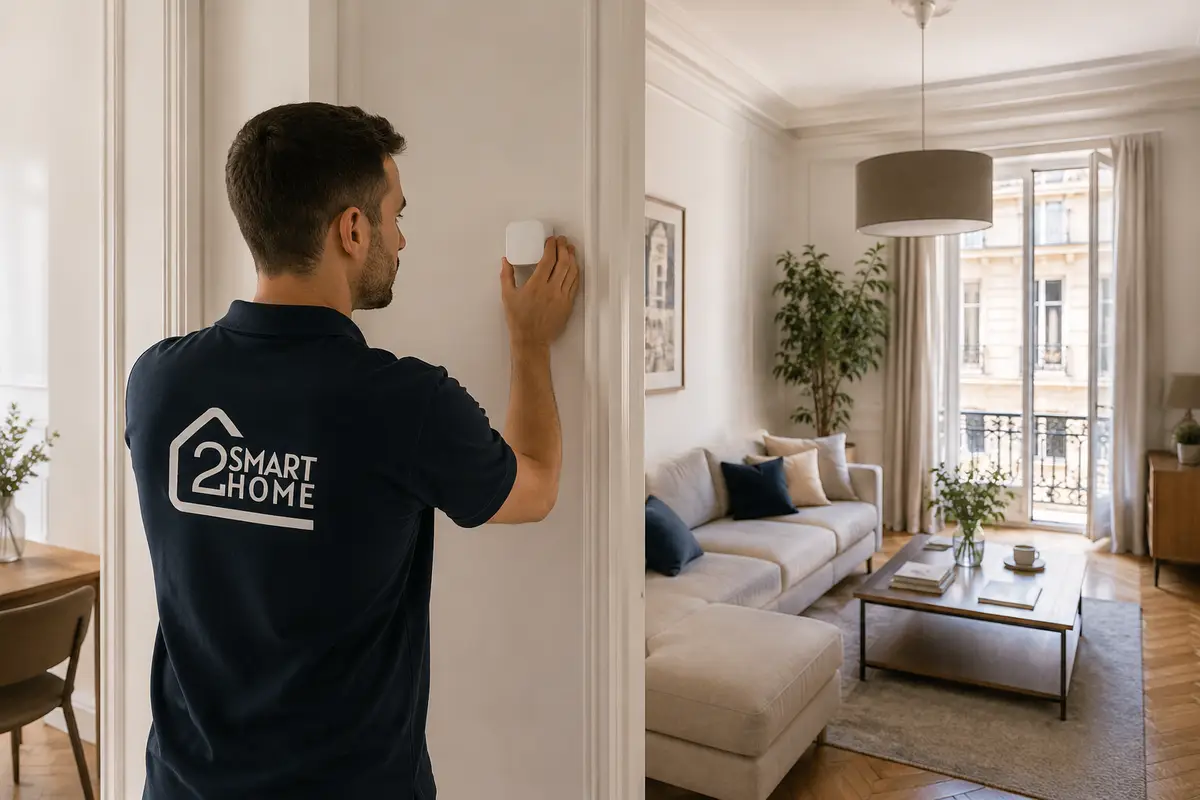
It's the concern we hear most often when we're preparing a quote: “my flat is already finished”, “we've just had it painted”, “I don't want to live with dust and walls cut open”. And it's understandable, because for years automating a home meant exactly that: opening up walls to run cables. Today, the short answer is no: in most cases home automation is installed with no building work, in homes that are already built, furnished and lived in.
What's changed isn't the marketing, it's the technology: today's systems are wireless, and the devices are fitted using what your flat already has — switches, sockets, radiators, the blind motor. In this guide we explain exactly what “no building work” means, what you can automate without touching a wall, when wiring really does make sense and what happens if you rent.
The short answer: no, in most cases
A modern home automation system is made up of devices that communicate by radio — using protocols such as Zigbee, Z-Wave, Thread or Wi-Fi — and a small central unit (the hub) that connects to your router and coordinates everything. Because communication happens over the air, there's no need to run a single new cable: each device is installed where the thing it controls already is.
One detail that surprises many clients: most of these devices don't even use your Wi-Fi. Zigbee, Z-Wave and Thread form their own independent, low-power radio network, designed so that a sensor can run for years on a button-cell battery. And if the system is set up properly, all the logic runs inside your home: it works on your local network, cloud-free, even if the internet goes down.
What “no building work” actually means
It means nobody opens up a wall in your home: no cutting into walls, no dust and no painters afterwards. The installation is done with your home just as it is — furniture included — and in most cases it's completed in a single day.
To be precise, “no building work” doesn't mean “no electrical work”. Some devices do involve working on your existing installation: a smart relay sits behind your existing light switch, in the wall box that's already there, and an energy meter goes in the fuse box. It's a job for an electrician — minutes per point, with the original switch put back in place — not for a builder: no walls are cut open and no new cabling is run. That's how we carry out all our smart home installations with no building work.
What you can automate without touching a wall
Practically everything you associate with a smart home now comes in a version that needs no building work:
- Lighting: compact relays behind your existing switches, or smart bulbs in the lamps you already have. Your walls and switches stay exactly as they are, and you gain scenes, schedules and presence-based control. It's the most common starting point: smart lighting from €600.
- Blinds: if they're already motorised, a matchbox-sized module inside the blind housing gives them smart control; if they're manual, a blinds specialist first has to motorise them (the motor goes inside the same housing), and then they're integrated in the same way. We go into detail in our guide on how to automate the blinds you already have.
- Climate control: a smart thermostat takes the place of your current one, radiators are zoned with battery-powered thermostatic heads that screw onto the valve, and the air conditioning is integrated via its infrared remote or its own connectivity.
- Security and sensors: battery-powered door and window, motion, smoke and flood sensors that stick on with adhesive; sirens and indoor cameras that only need a socket.
- Electricity use: smart plugs with energy metering for your appliances and, if you want the full picture, a meter in the fuse box — the only “serious” job on the list, and it still isn't building work.
When does wiring make sense?
We'd be less than honest if we said cables were dead. There are three situations where wiring is the right call:
- New builds or full renovations: if the walls are going to be open anyway, make the most of it: planning conduit and cabling from the design stage makes the system cheaper and gives you maximum freedom. This is exactly where traditional wired systems make sense.
- Blinds with no accessible housing: in some buildings there's no access panel to reach the motor, so one has to be opened up — a small, localised job, but a job all the same.
- Outdoor cameras: a camera exposed to the elements needs a permanent power supply; depending on the façade, that means trunking, surface-run cable or a small hole to pass the cable through.
In practice, most projects in existing flats are done 100% wirelessly, and when a renovation is involved we combine both worlds: cable where the wall is already open, radio for everything else.
How long it takes and how much it costs
Most of our installations are completed in a single day, configuration included: by bedtime, your automations are up and running. A complete home project — lighting, blinds, climate control and security, all coordinated by Home Assistant — starts from €2,500. And you don't have to do it all at once: that's another advantage of wireless. You can start with a single system, such as lighting from €600, and expand room by room without anything you've installed becoming obsolete.
What if I rent?
Home automation with no building work is especially appealing for tenants: everything that runs on batteries, sticks on with adhesive or plugs in — sensors, bulbs, smart plugs, radiator heads, the hub itself — can be taken down in an afternoon and moves with you to your next flat, without leaving a trace. Relays behind switches are reversible too (they're removed and the switch is left as it was), although since they sit inside the electrical installation, it's best to agree it with your landlord. Beyond that, you don't touch anything fixed in the property. We have a whole guide written for tenants: what home automation to put in a rented flat and take with you when you move.
Conclusion
The question is no longer whether you need building work to install home automation — you don't — but what you want to automate first. Wireless systems have turned what used to be a renovation project into a one-day installation that's scalable and fits your flat just as it is. If you'd like to know what your particular case would need, at 2SmartHome we'll look at it with you in your actual home, with no obligation.