
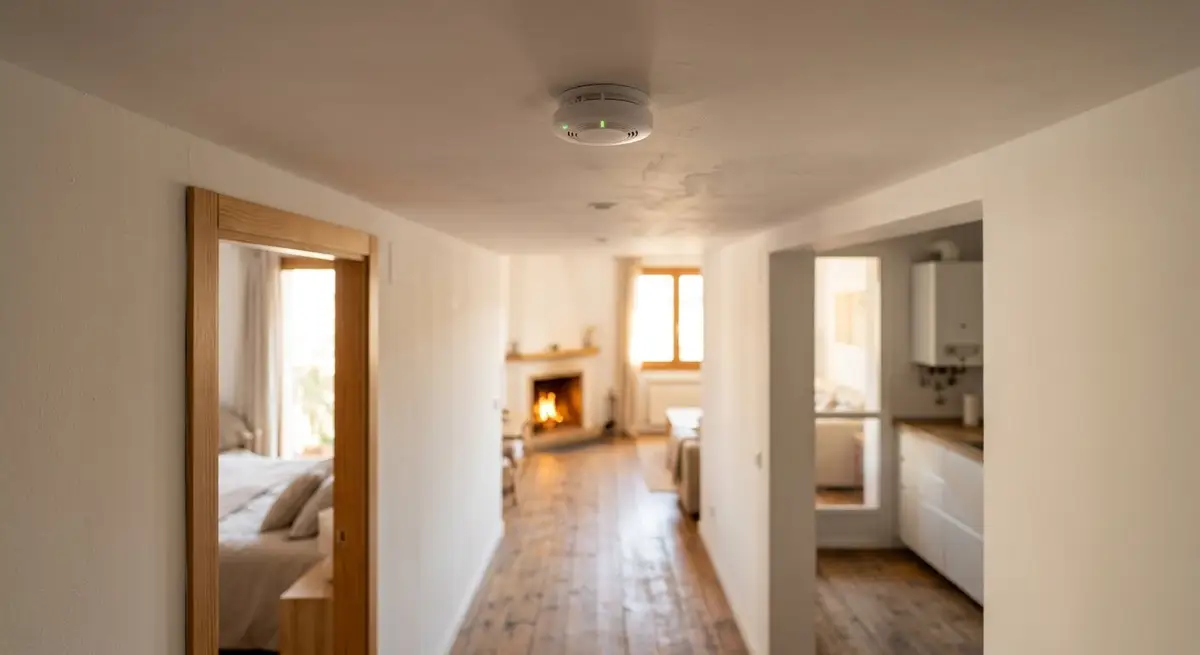
Almost everyone knows what a smoke detector is for: it beeps when there's a fire. What people think about less is that the beep is only any use if someone is at home to hear it. A conventional detector that goes off at eleven o'clock on a Tuesday morning, with the house empty, alerts the dog and, with a bit of luck, the neighbour across the landing, who can't tell whether it's a real alarm or a flat battery.
October is a good time to think about it. It's when the boiler comes on for the first time in seven months, the butane heater and the brazier come out of the storage room and the first fire of the season is lit in the fireplace. Everything in a home that burns fuel starts working again at the same time, and with it come two different risks that one device alone doesn't cover: fire and carbon monoxide.
Smoke and carbon monoxide: two dangers, two sensors
A smoke detector reacts to particles in the air: that's what a fire produces, from the very first minute, long before there's a visible flame. It's the device that wakes you up if something starts burning at night.
Carbon monoxide is something else. It's a colourless, odourless gas given off by poor combustion: a badly adjusted boiler, a water heater on an enclosed utility balcony, a butane heater in an unventilated room, a fireplace that doesn't draw properly. There's no smoke and no flame, which is why a smoke detector can't see it. You won't notice it either: the symptoms are headache, dizziness and drowsiness, exactly the kind of thing that won't make you suspect anything when you're on the sofa on a winter afternoon.
And there's a third device it's often confused with: the gas detector, which warns you of a leak of unburnt gas. It's useful if you cook with gas, but it doesn't replace either of the other two, and it goes at opposite heights depending on the gas: natural gas is lighter than air and builds up high; butane is heavier and stays down at floor level.
Where each detector goes
Catalonia's fire service, the Bombers de la Generalitat (in Catalan), sums up the basics of smoke detectors well: on the ceiling, not on the wall, as central in the room as possible and always more than 15 cm from the walls. Applied to a typical flat:
- The hallway outside the bedrooms. This is the essential one: it's where smoke passes on its way to where you sleep. If you sleep with the doors closed, add one inside each bedroom.
- The living room. It's where you'll find the TV, the chargers, the extension lead with far too many things plugged into it and, if you have one, the fireplace.
- The kitchen, but not with a smoke detector. Steam from the pans would set it off every day. What goes there is a heat detector, which reacts to a sudden rise in temperature: it covers the frying pan forgotten on the hob, without false alarms.
- Carbon monoxide, next to whatever burns fuel. One detector in the room with the boiler or water heater and another wherever a heater or fireplace is used, between one and three metres from the appliance and at the height the manufacturer specifies. If the boiler is on the utility balcony next to the kitchen, that's where the detector has to be.
What to avoid matters just as much: never place them directly above a radiator, next to a window or under the air-conditioning vent. Draughts divert the smoke and the alert arrives late.
What changes when the detector is connected
A connected detector is still, first and foremost, a detector: it has its own siren, its own battery and must carry its certification (EN 14604 for smoke detectors, EN 50291 for carbon monoxide detectors). Home automation doesn't replace any of that; it builds on it. When one goes off, several things happen at once:
- The alert reaches your phone, and the phones of whoever you choose: your partner, a relative, the neighbour with a spare key. That's the difference between finding out within ten seconds and finding out when you get back.
- Every siren in the house sounds, not just the one on the detector that went off. In a large flat or a two-storey house, a fire that starts in the living room downstairs has to wake whoever is asleep upstairs.
- The lights along the way out come on — hallway, entrance hall — at full brightness. At night, with smoke in the air, being able to see the door matters.
- Ducted heating and air conditioning switches off, if you have it, so it doesn't spread the smoke through the rest of the home.
With carbon monoxide the response is different, because the problem is different: the system can cut the heating demand to the boiler through the thermostat, switch on the extractor fan and alert everyone. If you already have zoned heating control, room by room, that command comes from the same system that decides the temperature in each room: there's nothing else to add.
As with the rest of the installation, detection and the sirens run locally, inside your home. If the router is down, the detectors keep detecting and the sirens keep sounding; the only thing that needs the internet is the notification to your phone.
If you already have detectors at home
There's no need to throw them away. There are two routes, and which one suits you depends on what you already have:
- Replace them with certified detectors that also speak Zigbee or Z-Wave. It's the cleanest option: each detector reports its status and battery level to the system, and which room it went off in.
- Keep them and add a “listener”. It's a small sensor that recognises the sound pattern of any detector's siren and turns it into an alert. It works for detectors that are still within their service life, at the cost of not knowing which one went off.
Either way, the installation is the same as for water leak sensors: battery-powered devices, with no wiring and no building work, that are paired with the system and put in place. In fact, they're usually installed together, because they cover the same idea: your home letting you know what's happening inside when you're not there.
What a connected detector doesn't do
It's worth saying clearly. Home automation doesn't call the fire brigade. It alerts you and whoever you choose, and it acts inside the home, but the call to 112, the emergency number, is made by a person. Having someone verify the alarm and call on your behalf is what an alarm receiving centre offers, for a monthly fee; for a flat that's lived in, it's almost always enough for the alert to reach two or three phones.
Nor does it make safe something that isn't. A carbon monoxide detector doesn't fix a badly adjusted boiler or a heater in an unventilated room: it tells you that it's happening. Regular boiler servicing and common sense with the brazier still come first. And every detector has an expiry date: smoke detectors after roughly ten years, carbon monoxide detectors after seven to ten. Built into the system, at least they tell you themselves before that day comes.
The house that's closed up
Where a detector that only beeps makes least sense is in a home that sits empty for weeks at a time. The mountain house with a fireplace, the holiday apartment you use on long weekends: if something catches fire or the boiler fails there on a Tuesday in November, nobody is going to hear it. It's the same reasoning we explain in home automation for a second home: what matters isn't that the house detects something, but that it tells you about it when you're two hours away.
How much it costs
Detectors aren't sold as a standalone product: they're one more part of the installation, and the price depends on what they're being added to. If you already have home automation, adding them is one of the simplest jobs there is: they're paired, fitted, and the scenes and alerts are configured in the same visit. If you're starting from scratch, they usually go into the security system, whose installation starts from €900 and includes the control panel, sensors, siren and configuration, with no monthly fees and no minimum contract.
The visit and the quote cost nothing: we come round, look at what burns fuel in your home and where everyone sleeps, and tell you how many detectors you really need, and of which type.
Common questions
Where should a smoke detector go in a flat?
On the ceiling, as central as possible and always more than 15 cm from the walls, as the Bombers de la Generalitat, Catalonia's fire service, recommend. The one spot you can't leave out is the hallway or inner hall that leads to the bedrooms; if you sleep with the doors closed, it's worth adding one inside each bedroom, plus another in the living room. Keep it away from windows, air-conditioning vents and ventilation ducts, because draughts divert the smoke and delay the alert.
Does a smoke detector detect carbon monoxide?
No. They're two different sensors for two different dangers. A smoke detector picks up particles in the air, which is what a fire produces; carbon monoxide is an invisible, odourless gas given off by poor combustion — a boiler, water heater, butane heater or fireplace that isn't drawing properly — with no smoke or flame at all. Some devices combine both sensors in a single casing, but if anything in your home burns gas, wood or coal, a carbon monoxide detector is essential.
Can I put a smoke detector in the kitchen?
It's not a good idea: steam and cooking fumes set it off constantly, and a detector that goes off every time you make a tortilla ends up disconnected. In the kitchen you fit a heat detector, which reacts to a sudden rise in temperature rather than to smoke. It covers exactly the typical case — the frying pan forgotten on the hob — without false alarms.
How often does the detector need replacing?
It's the whole device that needs replacing, not just the battery. Sensors age: smoke sensors last about 10 years and carbon monoxide sensors between 7 and 10, depending on the model, and the replacement date is usually printed on the casing. What helps most is a detector that warns you by itself when the battery is running low or when it reaches the end of its service life; built into the system, that warning reaches your phone instead of being a beep at three in the morning.
Does the system alert the fire brigade?
Not on its own. Home automation alerts you and the people you choose — a relative, the neighbour with a spare key — and acts inside the home, but the call to 112 is made by you or whoever receives the alert. Having someone verify the alarm and call on your behalf is exactly what an alarm receiving centre sells, for a monthly fee. For most flats, an alert on several people's phones is enough; for an isolated house or a second home, it's worth giving it some careful thought.
In short
A smoke detector protects you from fire; a carbon monoxide detector, from the gas given off by a boiler, heater or fireplace that isn't working properly. They're two different devices, and a home with fuel-burning heating needs both. Connected to the system, they stop being a beep that only someone inside can hear: the alert reaches your phone, every siren sounds, the way out lights up and the boiler stops. It's the difference between the house detecting something and someone finding out in time.