
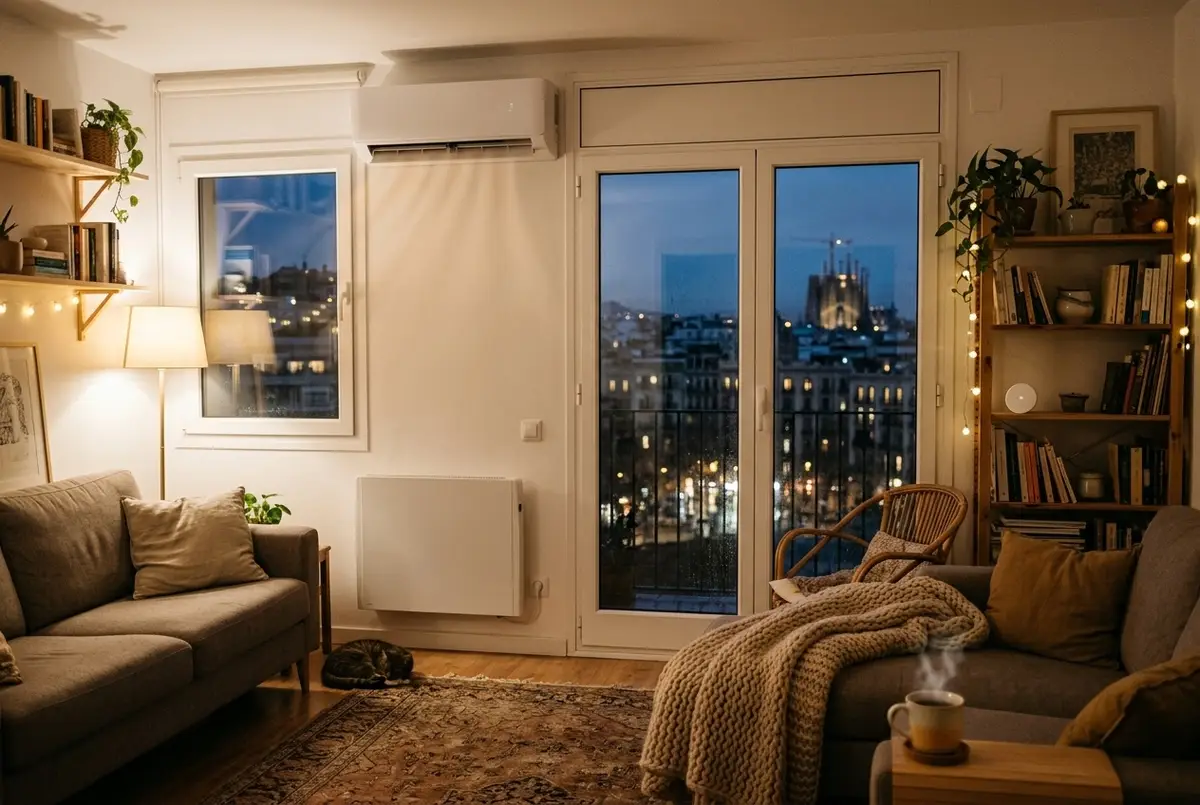
Plenty of flats in Barcelona have no gas: the heating is the split unit in the living room, an electric radiator or two in the bedrooms and, in some buildings, old-style storage heaters. Almost everything written about smart heating assumes a boiler, and if that's you, what you need is a smart thermostat for the boiler. This guide is for everyone else.
The good news is that electric heating lends itself very well to home automation. Without a boiler, heating is electricity, and electricity can be measured, shared out and moved to other times. What follows is how to do that with each appliance, what's best to switch on first and what should never be scheduled.
Three ways to heat without gas, and which uses least
Not all electric appliances heat the same way, and the difference shows on the bill.
- The split unit in heating mode. A modern air conditioner is a heat pump: in winter it draws heat from the outside air and brings it indoors. That's why, for every kWh of electricity, it delivers several kWh of heat. Exactly how many appears on its energy label, in the heating figure (the SCOP).
- The electric radiator or panel heater. It heats a resistance element: every kWh of electricity becomes one kWh of heat, no more and no less. It's simple and quickly warms a small room, but it's the most expensive way to produce heat.
- The storage heater. Inside, it works just like a radiator, with one difference: it stores heat in a block of firebricks and releases it through the day. That's why it charges at night, when electricity is cheapest.
The IDAE, Spain's energy agency, sums it up in its energy-saving advice for homes (in Spanish): if you need to both cool and heat your home, go for a heat-pump unit with an energy label of A or higher. And Barcelona's climate helps: according to the climate normals from AEMET, Spain's state meteorological agency, at the airport January averages 9.2 °C with average lows of 4.7 °C, and in cold that mild a heat pump works in very good conditions. The practical upshot is an order of priority: the split first, and radiators where the split doesn't reach.
The split in winter: warm before you arrive, not all afternoon
The usual mistake with a split unit is leaving it on all afternoon just in case, or switching it on when you get home and waiting half an hour with your coat on. Both are fixed with the same idea: the split knowing when someone is home and when someone will be.
- Your home's schedule, not the factory one. Heat at the times the home is used — before breakfast, when you get back in the afternoon — and at a minimum the rest of the time.
- Arriving to a ready home. When the first phone in the family heads home, the split starts just in time for the flat to be warm when you open the door.
- At a minimum when nobody's in. The IDAE advises turning the thermostat down to 15 °C if you're away for a few hours; your home does it by itself as soon as the last person leaves.
- Window open, split off. A sensor on the window stops it after a few minutes and switches it back on when the window closes.
As for the temperature, the IDAE points out that 21 °C with suitable clothing is enough. We go into what temperature to set in each room and at what time in our guide to zoned heating; here what matters is that the split respects it, instead of heating to 25 °C to make up for the time it was off.
Fixed electric radiators: one per room, each with its schedule
Where the split doesn't reach — a bathroom, a bedroom at the end of the hallway — there's usually a fixed electric radiator on the wall, a panel heater or a heated towel rail. They're controlled with a relay or with a smart plug that measures power, and each one gets its own schedule: the bathroom one half an hour before the shower, the bedroom one a while before bed.
The piece that changes the result is a temperature sensor in the room itself. The dial thermostat on the radiator measures the air right next to it, which warms up straight away, so it keeps cutting out and back in while the room is still cold. With a sensor at mid-height, the system keeps the radiator on until the room reaches its temperature and switches it off then, not when the appliance thinks it's done enough. And the plug's meter shows what each one uses: there's often one using far more than anyone thought.
Storage heaters: charging at night according to tomorrow's cold
Storage heaters have a reputation for being expensive, mostly because of how they're used. They're designed to charge at night, when electricity is cheapest, and release the heat during the day. The trouble is that the charge is set by hand and hardly anyone touches it: they charge the same on a 12 °C night as on a 3 °C one, and the next day there's either too much heat in the afternoon or not enough in the morning.
With the system, how many hours each one charges every night is decided using the next day's forecast and the temperature in each room: more charge if tomorrow will be cold, less if a mild day is coming or the home will be empty. The charging still happens in off-peak hours, which is the whole point, but in the amount that's needed.
The limit you can't see: contracted power
Electric heating brings a problem that doesn't exist with gas. A flat in the metropolitan area usually has 3.45 or 5.75 kW of contracted power, and each electric radiator draws between 1,000 and 2,000 W. Two radiators and the hob at the same time already go over 3.45 kW, and the limiter cuts the power to the whole flat.
The expensive way out is increasing your contracted power, which you pay for every month of the year for a few hours of winter. The cheap one is sharing out the load: the system knows the home's power use in real time, staggers when the radiators start and, if the oven comes on, holds one back for a few minutes without anyone noticing. It's the same idea, with the same clamp in the consumer unit, that we use to charge an electric car at home without increasing the contracted power.
What isn't scheduled: portable heaters
There's a rule we always apply: nothing that needs someone in the room is switched on remotely. Portable heaters, fan heaters and oil-filled radiators fall under it. They can tip over, get covered by a blanket or end up a hand's width from a curtain, and their own manuals usually warn against connecting them to timers or programmers that switch them on automatically.
What does make sense is the opposite: a metering plug that shows what they use and switches them off if they're left on in an empty home. But if a room can only be heated with a portable heater, the real answer isn't to schedule it: it's a fixed wall-mounted heater, or getting the split to reach it.
What you need (and what it costs)
For a typical flat without gas: integrating the split units — over Wi-Fi or with an infrared transmitter, with no building work — a relay or metering plug for each fixed radiator or storage heater, a temperature sensor per room and, if the power is tight, a clamp in the consumer unit. It all goes into the same smart climate control system, which works locally: you only need the internet to control it from outside the house and to get alerts.
An installation like this starts from €700, as a one-off payment with no monthly fees; the number of appliances and the state of the consumer unit are what move the figure most, and we look at that during the visit, with no obligation. It comes with the same warranty as everything else we install: we guarantee our installation and configuration for 5 years. The devices carry their manufacturer's warranty (2–3 years), and we handle it for you.
Common questions
Which uses less, the split unit or an electric radiator?
For the same amount of heat, the split unit in heating mode uses a good deal less, because it's a heat pump: it draws heat from the outside air and for every kWh of electricity it delivers several kWh of heat. An electric radiator turns each kWh into one kWh of heat, no more and no less. Exactly how efficient your split is appears on its energy label, in the heating figure (SCOP). That doesn't mean getting rid of the radiators: in a bathroom or a bedroom without a split they're still the simple way to heat, and what matters is that they only run when needed.
My split unit is old — can it heat?
If it's a heat pump, yes: the remote has a heating mode, usually with a sun symbol, and the label shows heating figures as well as cooling ones. Cooling-only units don't heat, however they're programmed. And an old split that does heat can be integrated just like a new one, over Wi-Fi or with an infrared transmitter; we check it during the visit.
Will the power trip if I switch on several radiators at once?
It can. Each electric radiator draws between 1,000 and 2,000 W, and a flat with 3.45 kW of contracted power can't cope with two radiators and the hob at the same time. The system prevents it by sharing out the load: it staggers when the radiators start and, if the oven comes on, holds one back for a few minutes. Increasing your contracted power is the other way out, but you pay for it every month of the year.
Can I schedule my portable heater or oil-filled radiator with a smart plug?
Not to switch it on remotely. Portable heaters are designed to be used with someone in the room: they can tip over, get covered by a blanket or end up next to a curtain, and their own manuals usually warn against connecting them to timers that switch them on automatically. What does make sense is the opposite: measuring what they use and having them switch off by themselves if they're left on in an empty home. If a room can only be heated with a portable heater, the real answer is a fixed wall-mounted heater or the split.
I'm renting — can the heating be automated?
Almost always. Split units are controlled with a small infrared transmitter placed on the wall or a piece of furniture, without touching the unit; the temperature sensors run on batteries and stick on with adhesive; and the little device that coordinates it all plugs into the router. Only the relays that go behind a fixed radiator or in the consumer unit involve the electrical installation, and those are worth discussing with your landlord first.
In short
In a flat without gas, heating is a question of electricity, and that works in your favour: it can be measured, shared out and moved to other times. The split first, which in Barcelona's mild winter gives several times more heat than it uses; fixed radiators in the rooms the split doesn't reach, each with its own sensor; storage heaters charged according to tomorrow's cold; and load sharing so the power doesn't trip. Portable heaters, always with someone in the room. Without a boiler you can still have heating that thinks: you just have to teach it when, where and in what order to heat.