
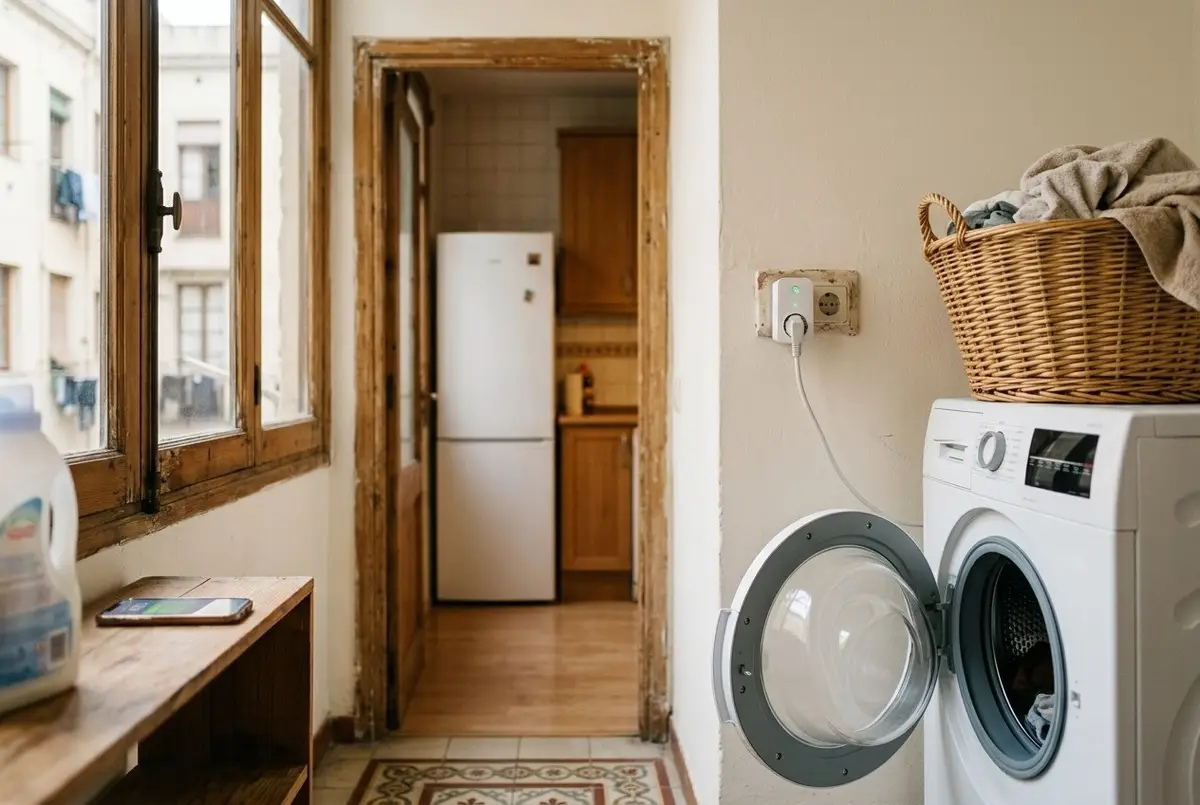
Three small slip-ups that happen every week. The washing machine finished an hour and a half ago and the clothes are still inside, damp and creased, because nobody heard the beep from the living room. The terrace door stayed open all afternoon, with the heating on. And one morning the freezer door is found ajar, the ice dripping and the question of what can be saved. None of it is serious, but all three have something in common: your home knew before you did, and didn't tell you.
The opposite problem is just as common. People who install connected sensors and plugs often end up with an alert for everything that happens at home, and by the second week they've muted the lot — taking with them the one that really matters, the water leak or the smoke alarm. So this guide isn't about how many things your home can tell you, which is a great many, but about which ones deserve to reach you. An alert that doesn't make you do anything is one too many.
Few alerts, each with something to do
Before setting up a single alert, it's worth sorting them into three levels, because each is handled differently.
- Urgent. Water on the floor, smoke or carbon monoxide, someone coming in with the alarm on. These always get through, with sound, to everyone you choose, and they're never muted at night. There are few of them and they hardly ever go off, which is exactly what gives them their value.
- Useful. The washing machine has finished, a door has been open for a while, the fridge hasn't shut properly. These arrive silently and only for whoever they're useful to: whoever is at home at the time, or whoever that job falls to.
- Informative. Today's energy use, the bedroom temperature, the battery in a sensor that still has weeks left. These aren't notifications at all: they're on the dashboard, for whenever you want to look.
And three rules for the useful ones. They should give the reason, not just the fact: "the terrace door has been open for twenty minutes" makes sense at a glance, while "terrace door: open" makes you think. There should be one reminder at most, not a string of alerts every five minutes. And they should respect quiet hours: at one in the morning, your phone should only ring for something urgent.
The washing machine has finished
This is the most welcome alert and the simplest to set up. The washing machine is connected to a smart plug with power metering, and the system learns how it works: while it's washing, it draws power; when it heats the water, it draws a lot; and when it finishes, it drops to almost nothing. That last change is the alert: "the washing machine has finished".
The trick is not to alert too early. Mid-cycle there are pauses — soaking, the rest before the spin — when the machine also drops to almost nothing for a while. A simple drop in power isn't enough: the alert goes out when the power has stayed low for several minutes in a row after the machine has been working, not at the first dip. Tuned to your washing machine, it doesn't get it wrong.
Two things need checking first. One, that the plug can take it: a washing machine heating water or a tumble dryer goes above 2,000 W, and plenty of small smart plugs aren't built for that. If the wall socket is behind the machine or there's no room, the meter goes behind the socket itself, with nothing visible changing. Two, where nothing electrical can be touched, a vibration sensor stuck to the washing machine does a similar job, if a less precise one.
The same goes for the tumble dryer, where the alert is the difference between folding clothes while they're still warm and having to iron them, and for the dishwasher, where it's a cue to open the door at the end so the dishes dry with their own heat. It also fits with what we explain about shifting the washing machine to off-peak hours: if you leave it ready to start first thing, on cheap electricity, the alert tells you when it's done.
The door or window that's been left open
This uses the same opening sensors an alarm has: two small battery-powered pieces that stick on with adhesive, one on the frame and one on the door or window itself. The difference is what's done with them. With the alarm armed, a door opening is an intrusion. The rest of the time, a door left open is just something forgotten, and what helps is for someone to find out in time.
There are three moments when that alert pays off:
- When you leave. When the last person goes out, the system checks the doors and windows and, if anything is still open, names it: "the bathroom window has been left open". It's the moment when you're still on the stairs and can go back.
- When you go to bed. A single summary at bedtime — or when you press the goodnight button — if the terrace or garage door is still open. If everything is shut, nothing arrives.
- When it's been open too long. The front door, the terrace door or the garage door left open longer than usual — ten minutes, twenty, whatever makes sense in your home — deserve an alert to whoever is at home.
And one combination that's welcome in autumn: a window open with rain forecast within the hour. The alert gives you time to close it before the floor gets wet. What you don't need is an alert every time someone opens a door: that's watching, not alerting. It's the same idea behind the arrival notice we describe in our back-to-school automations: a "they're home" and nothing more, just enough information to put your mind at rest.
The fridge and the freezer
A fridge fails in two ways, and you can see both coming with a sensor. The first is a door that isn't properly shut: a container sticking out, a drawer pushing the door, someone leaving it ajar in a hurry. Many fridges beep, but nobody hears that beep at night, or when the freezer is in the storage room or the garage. An opening sensor on the door, just like the one on a window, alerts you if it's still open after a few minutes.
The second is temperature. According to the Catalan Food Safety Agency (ACSA) (in Spanish), the fridge should be at 4 °C or below and the freezer at −18 °C. A temperature probe inside each one keeps an eye on those figures and alerts you if the temperature rises and doesn't come back down: a door that doesn't quite close, a worn seal or an appliance starting to fail. A practical detail: the metal door and the insulation weaken the signal from a wireless sensor placed inside, so the usual answer is a probe on a thin cable that runs past the seal, leaving the sensor itself outside.
A metering plug completes the picture: if the appliance is still drawing power as usual, it's still cooling. And the probe is the piece you'll be most grateful for after a power cut, when the question is whether what's in the freezer is still safe to eat; we cover that in what happens to your smart home in a power cut.
Alerts without a phone
Not everyone wants more notifications on their phone, and not everyone at home has one. An alert can also be a light: the one in the hallway or the kitchen, changing colour for a while when the washing machine finishes or blinking if a door has been open too long. And if the home has built-in speakers, the alert can be a sentence spoken in the room you're in. All of this works locally, without going through the internet, and it's the kindest way to let someone know who isn't glued to their phone.
What you need (and how we quote for it)
Not much, and no building work: metering plugs for the washing machine, the tumble dryer or the fridge, opening sensors on the doors and windows that matter, and temperature probes in the fridge and freezer. It all goes into the same system as your home energy management, so the plug that tells you the washing machine has finished is the same one that measures what it uses. It works locally: only the alerts on your phone and checking things from outside the house need the internet.
We don't give a fixed figure here, because it depends on how many alerts you want and what you already have at home. We quote for it during the visit, with no obligation, as a one-off payment with no monthly fees. It comes with the same warranty as everything else we install: we guarantee our installation and configuration for 5 years. The devices carry their manufacturer's warranty (2–3 years), and we handle it for you.
Common questions
Will any smart plug do for the washing machine?
Not just any. It has to measure power, because that's what tells you the cycle has finished, and it has to handle the appliance's load: a washing machine heating water or a tumble dryer goes above 2,000 W, and plenty of small smart plugs fall short. If the wall socket is behind the machine or there's no room, a meter goes behind the socket itself. And where nothing electrical can be touched, a vibration sensor stuck to the washing machine does a similar job, if a less precise one.
Can several people get the alerts?
Yes, and each alert can go to whoever it's useful to. The urgent ones — water, smoke, someone coming in with the alarm on — reach everyone you choose, with sound. The everyday ones can go only to whoever is at home at the time, or to whoever's turn it is to hang the washing out that week, silently. That way nobody hears, in the middle of a meeting, that the washing machine at home has finished.
Do the alerts work if the internet goes down?
The detection does: the washing machine's power use, the door sensors and the fridge probe are read by the small device in your home, without going through any outside server. What needs the internet is getting the alert to your phone. That's why alerts inside the home — a light that changes colour, a spoken message through a speaker — keep working even if your fibre connection is down.
My washing machine or fridge already has an app — isn't that enough?
It may be enough for that appliance. The trouble is that each brand alerts you in its own app and through its own cloud, and every new appliance means one more app and one more account. Where possible, we bring that appliance into the same system as the rest of the home; where not, a metering plug or a sensor does the job with any washing machine or fridge, app or no app, and all the alerts arrive in the same place.
Can I have it if I'm renting?
Yes. The metering plugs just plug in, the door sensors and the fridge probe run on batteries and stick on with adhesive, and the little device that coordinates it all plugs into the router: none of it leaves a mark or needs the landlord's permission, and it all comes with you to your next flat. Only the meter that goes behind the wall socket involves the electrical installation, and that one is worth discussing with your landlord first.
In short
A connected home can tell you about almost anything, which is exactly why you have to choose. Urgent alerts always, with sound; useful ones silently, and only to whoever they help; the rest on the dashboard. With that rule, three simple alerts — the washing machine that has finished, the door left open, the fridge that won't shut or is warming up — take care of each week's small slip-ups without turning your phone into a doorbell. An alert that doesn't make you do anything is one too many; one that arrives in time is welcome every week.