
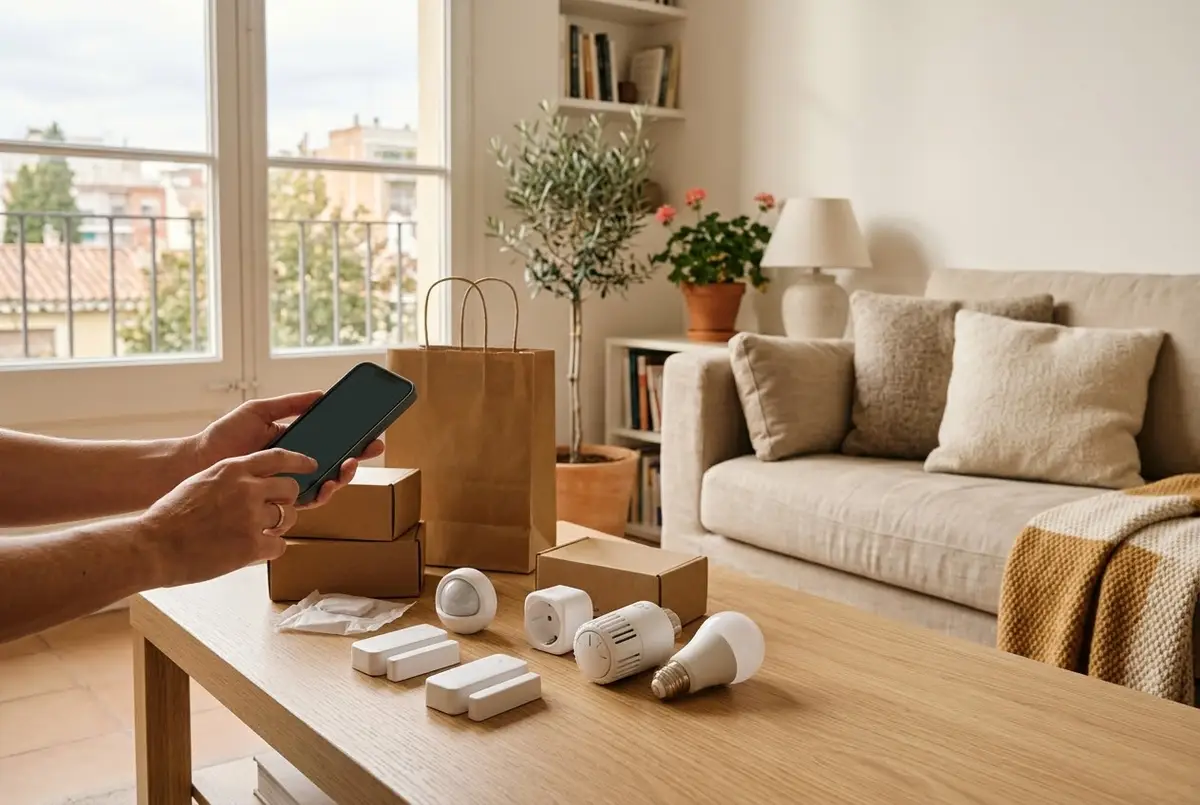
This year Black Friday falls on Friday 27 November, and many shops stretch their deals across the whole week. It's the time of year when more connected plugs, bulbs, cameras and robot vacuums sell at half price than any other — and also when more drawers fill up with gadgets that don't talk to anything. The problem is rarely the price: it's buying something that only works with its own brand's app and cloud, and finding out later that it doesn't fit with the rest of the home.
This guide isn't a list of deals, which change by the hour. It's what we'd check before adding anything to the basket: which questions to ask the box, what's worth buying on offer and what we wouldn't buy just for the discount. A good deal is one that fits what you already have.
Before you look at the price: three questions
Three questions separate a good device from one that will end up in a drawer, and all three can be answered by reading the product details carefully.
- Does it work locally, without the manufacturer's cloud? If switching on a lamp means the command has to reach a manufacturer's server and come back, the day the internet goes down — or the brand shuts its service — the device stops responding. We explain it in depth in what cloud-free home automation means, and it's the first thing to check.
- Which protocol does it use? Zigbee, Z-Wave, Thread, Matter or Wi-Fi. The first four are designed so that lots of devices from different brands can live together in one system; the Wi-Fi of many cheap devices, less so. With Matter, the device can also be added to Alexa, Google Home or Apple's Home app, although with caveats we cover in how to set up a smart home that works with Alexa, Google Home and HomeKit.
- Does it force you to pay monthly fees or use its own app? Some cameras only keep recordings if you pay a subscription, and some kits can only be set up with their brand's app. If so, the price on the box isn't the real price.
If a device passes all three, the discount is good news. If it doesn't, it's expensive even at half price.
What's worth buying on offer
The best value comes from the small, discreet pieces — the ones with no screen and no app of their own that matters: they do one thing, do it well and fit into any serious system.
Sensors
Contact sensors for doors and windows, motion or presence sensors, temperature and humidity sensors, and water leak sensors. They're cheap, battery-powered, stick on with adhesive and are the basis of almost everything an automated home does: turning the light on when you walk in, warning you about an open window as you leave, switching the heating off when someone airs a room or shutting off the water if there's a leak. Ideally Zigbee or Matter over Thread, which use little power and form their own network without loading up the Wi-Fi.
Plugs with energy monitoring
A smart plug that also measures what the appliance uses does much more than switch on and off: it tells you when the washing machine has finished, shows which appliances draw power even when they're off, or runs the Christmas lights on the balcony. Before buying, check the load it can handle: a washing machine, a tumble dryer or an electric radiator easily goes over 2,000 W, and many small plugs aren't made for that.
Thermostatic radiator valves
If your heating is a boiler with water radiators, smart valve heads replace the dial on each radiator and let you give every room its own temperature and schedule. With winter just around the corner, they're among the purchases that show up on the bill soonest. They only work with water radiators: with electric radiators or a split air conditioner, they do nothing.
Compatible bulbs and switches
Smart bulbs are the most common way in, and on offer they're very good value. The condition is the same as before: they should be Zigbee or Matter, or controllable locally by your system. And a tip to avoid mistakes: if the light is switched off at the wall, the bulb loses power and stops responding, so in many rooms a smart switch or a micro-module behind the existing switch is a better buy than replacing every bulb.
What we wouldn't buy just for the discount
It's not that these products are bad; it's that their sale price hides costs or problems that show up later.
- Cameras that only record to the cloud. Many cheap cameras store footage only on the manufacturer's servers, and seeing more than the last few seconds means paying a monthly subscription. What you want are cameras that record locally, to a card or to a device at home; we cover this in home security cameras with local recording and no monthly fees.
- A smart lock bought without checking the door first. It's one of the most returned purchases, because not every door takes every lock: the cylinder, the type of door and the space on the inside decide. Before jumping on a deal, check whether your door can take a smart lock.
- Closed single-brand kits. A bundle of sensors and a hub at a good price is tempting, but if the hub only talks to that brand's app, every piece you add ties you a little more to it. If the kit uses Zigbee or Matter and other systems can read its sensors, go ahead; if not, today's saving is tomorrow's problem.
- Brands that don't publish updates. A connected device needs updates for years, for security and to keep working with new apps. If you can't find a support site or release notes for a brand's latest updates, better keep it out of your home, however cheap it is.
- Twenty Wi-Fi devices in one go. Every Wi-Fi plug or bulb is one more device connected to your router, and with many of them some home routers start to struggle. For lots of devices, mesh protocols like Zigbee or Thread cope much better.
The crossed-out price and your rights
Three things worth keeping in mind for any Black Friday purchase, smart home or otherwise:
- The previous price has to be real. Under article 20 of Spain's Retail Trade Act (in Spanish), the crossed-out price shown next to a discount must be the lowest that product has had in the previous 30 days. Raising it early in the month to “discount” it on the Friday doesn't count.
- Fourteen days to return it if you buy online. For distance purchases you have 14 calendar days from receiving the item to withdraw without giving a reason, with some exceptions; the Spanish government's returns guide (in Spanish) sums it up. That's your window to check that the device works locally and fits what you have.
- Three years' guarantee. New products bought since 1 January 2022 have a three-year legal guarantee from the seller, as noted by the Ministry of Consumer Affairs (in Spanish). Keep the receipt: without it, claiming gets complicated.
If you want to automate your home later
Buying on offer and automating later aren't at odds, as long as you buy with the system in mind rather than the box. The idea is simple: everything that comes into your home should be able to talk to the same brain, running locally, so a sensor from one brand can switch on a light from another and the home doesn't depend on five different apps.
If you're unsure about something specific, tell us beforehand what you're planning to buy and what you already have at home, and we'll let you know whether it fits. It's much easier to get it right before buying than to find a place afterwards for a device that only talks to its own app.
Common questions
Do cheap Wi-Fi plugs and bulbs work without the internet?
Many don't. The cheapest ones usually work through the manufacturer's cloud: the command leaves your phone, travels to their servers and comes back to your home, even if the device is two metres away. If the fibre goes down, or the brand shuts its service, they become an ordinary plug or bulb. Before buying, check whether they work locally: that they're Zigbee, carry the Matter logo or can be controlled by your system without going through the cloud.
How do I know whether the crossed-out price is a real discount?
By law, the previous price shown next to a discount must be the lowest price that product has had in the previous 30 days. If a shop raises the price in early November to “discount” it on the Friday, the crossed-out price doesn't comply. The practical approach is to check the price a few weeks before — many comparison sites keep a price history — and, if something looks off, complain to the consumer authorities.
Should I buy the devices now and have them installed later?
You can, as long as you buy with the system in mind rather than the deal. What can't be fixed is a device that only works with its own brand's app: bought at half price, it still sits outside the rest of the home. If you're planning to automate your home later, tell us beforehand what you'd like to buy and we'll let you know whether it fits; keep the receipts, because the warranty depends on them.
Is a single-brand starter kit worth it?
It depends on who that kit can talk to. If its hub is Zigbee or Matter and other systems can read its sensors, it's a cheap way to get started. If its hub only talks to that brand's app, every piece you add ties you a little more to it, and the day you want to combine it with something else you'll have to start from scratch. Check which protocol it uses on the box before you look at the discount.
In short
Before adding smart home gear to your basket this Black Friday, five quick checks:
- It works locally, without depending on its brand's cloud.
- It uses an open protocol — Zigbee, Z-Wave, Thread or Matter — that your system understands.
- It doesn't make you pay monthly fees for the basics.
- The crossed-out price is the lowest of the last 30 days.
- You keep the receipt: you have 14 days to return it if you buy online, and three years' guarantee.
Sensors, plugs with energy monitoring, radiator valves and compatible bulbs are the purchases that pay off most on offer. Cameras with monthly fees, locks bought without checking the door and closed kits deserve a second thought. A bargain that doesn't fit your home isn't a bargain.