
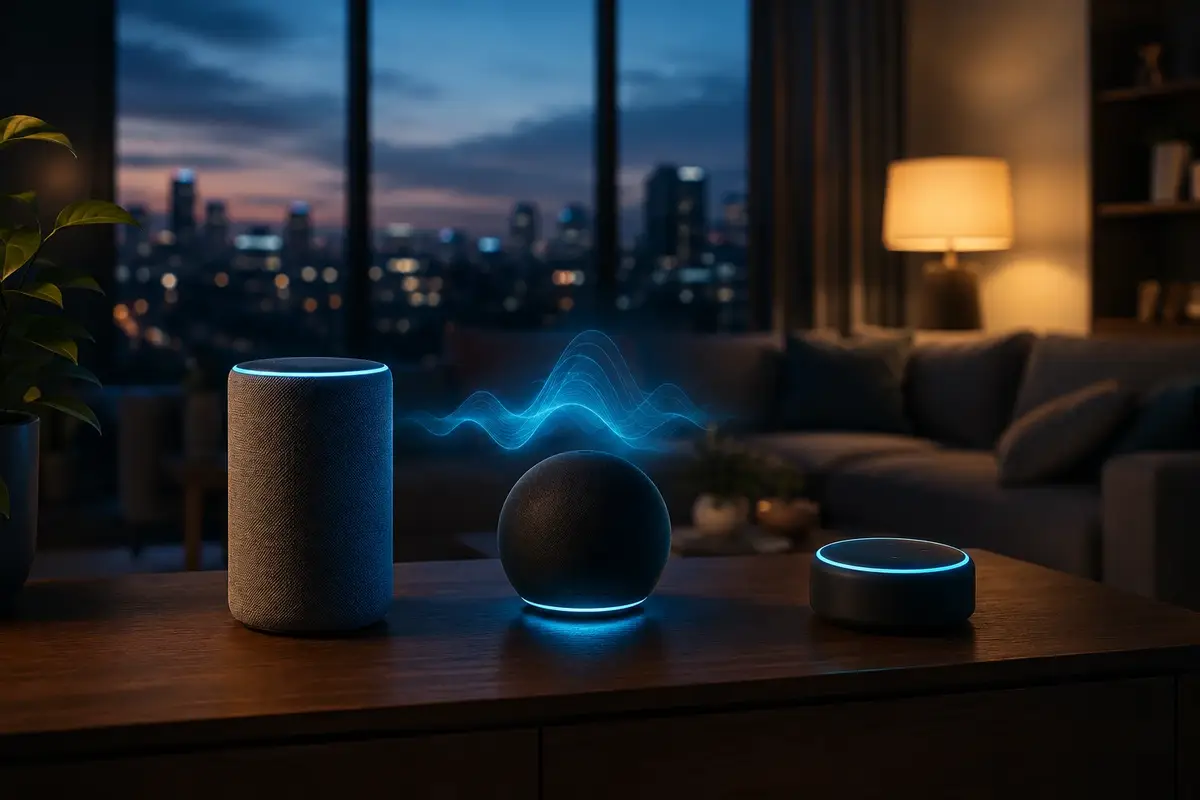
There's one question that comes up on almost every visit, often before the price: “And will this work with my Alexa?” Or with the Google speakers in the living room, or with the whole family's iPhones. The short answer is yes. The long answer is the one that matters, because it decides something more serious: whether your home is going to stay tied to one brand or get on with all of them — today's and whichever come next.
The underlying misunderstanding is that for years we've been calling the speaker “home automation”. And the speaker is only the voice. Home automation is something else: the system that knows which lights you have, when to lower the blinds and what to do if a sensor goes off. Set up properly, the two get on famously; mixed up, they end up in the drawer of gadgets that “don't talk to each other”. Let's take it one step at a time.
The assistant isn't the home automation (understanding this saves you headaches)
Inside, an Echo or a Nest Mini is a microphone, a speaker and a connection to its manufacturer's servers. When you say “turn on the living room light”, the device doesn't turn anything on: it sends the phrase to its cloud, the cloud interprets it and passes the command on to whatever is really running the house. If nothing is — if every bulb comes with its own app and its own account — the assistant turns into a phone book of brands: it works, but each manufacturer imposes its own limits, its own permissions and its own server outages.
We do it the other way round: brain first, voices second. The brain is an independent system that runs in your home and integrates every device — lights, blinds, climate control, sensors — whatever the brand. The assistants connect to that brain, not to each device. The practical upshot: anything integrated into the system can be controlled from Alexa, Google and Siri at the same time, even if the bulb's manufacturer has never heard of any of the three.
Alexa, Google Home and HomeKit: how they really differ
If you don't have a speaker yet and you're wondering which one to buy, the good news is that, with an independent brain, the choice becomes far less dramatic: you pick the one you most enjoy using, not the one that “supports” your home. Even so, there are honest differences:
- Alexa (Amazon). The biggest range of speakers and the most aggressive prices — an Echo Dot on offer costs less than a meal out. Its routines are decent, the community is huge and there's a speaker for every corner. The trade-off: it's the one that least lets you forget there's a shop behind it.
- Google Home / Nest. The best at understanding how we actually talk: it strings questions together, copes with half-finished sentences and answers more naturally. If your household already lives in Android and Google Calendar, it slots straight in.
- HomeKit / Siri (Apple). The strictest on privacy and the one that runs the most control inside your own network. The trade-off: it needs a “hub” — a HomePod or an Apple TV — for automations and remote control, and officially certified devices are fewer and pricier. Although, as we'll see, there's a trick to that.
The trap is choosing a speaker as if you were marrying it. With an independent system in the middle, the speaker is a peripheral: you can swap it, mix it with others or retire it without touching the installation.
Matter and Thread: the end of “will it be compatible?” (with caveats)
Matter is the serious attempt to put an end to the question in this article's title. It's a common standard driven by Amazon, Google and Apple together within the Connectivity Standards Alliance: a device with the Matter logo can be added to Alexa, Google Home or Apple's Home app interchangeably, without going through the manufacturer's app. Thread is its travelling companion: a low-power mesh network designed so that sensors and bulbs can talk to each other without loading up the Wi-Fi.
The caveats: Matter is advancing one device type at a time and doesn't yet cover every device or every function. The basics — on, off, dimming, measuring — work smoothly; each manufacturer's special features sometimes fall outside the standard. That's why today we still build the foundations of the home on veteran protocols like Zigbee and Z-Wave, which have been solving this very problem for years, and add Matter where it brings something. The direction is right; the promise of “buy anything and it'll work with everything” isn't quite real yet.
The winning move: a home that talks to all three at once
This is where the independent-brain approach wins the game. We build it on Home Assistant, the platform we use as the brain of the home: devices are integrated just once — via Zigbee, Z-Wave, Wi-Fi or Matter — and the whole system is exposed to Alexa, Google Home and HomeKit simultaneously.
In practice: the Echo in the kitchen, the Nest in the living room and your partner's iPhone all see the same lights, the same blinds and the same thermostat. Everyone talks to their own. And when someone switches from Android to iPhone — or the other way round — the house doesn't even notice: you install an app and that's that. Even the devices work out cheaper, because you no longer have to pay the premium for the “works with” badge: all the device needs is to integrate with the system, and the system takes care of compatibility with all three.
And if the internet goes down?
Let's not beat about the bush: Alexa's and Google's voices live on their servers. If your connection drops, the speakers go silent — nobody can fix that. What you can choose is what happens to everything else. Because the system runs inside your home, automations, physical buttons and the app on your local network carry on working exactly the same: voice is a convenience, not a single point of failure. It's the same principle we explain in depth on our cloud-free home automation page: the essentials of your home can't depend on somebody else's server.
What we look at on the visit (so voice isn't just for show)
When we come to see a home, the conversation about assistants comes down to three questions: which phones there are in the house (an Android + iPhone mix is the norm, not the exception), which speakers you already have — there's almost always a forgotten Echo or Nest doubling as a music speaker — and what you really want to ask the voice to do. With that, we decide what gets exposed to each assistant and what stays in automations, which is where a well-built home does 90% of the work without anyone saying a word.
Everything else is the same as with any smart home installation: no building work in the vast majority of flats, with the speakers you already have — whatever the brand — and a complete installation from €2,500. As always, the visit and the quote come with no obligation.
Common questions
Do I need to buy new speakers to have home automation?
No. Home automation works from the app and, above all, through automations — presence, schedules, sensors — even if there isn't a single speaker in the house. The speaker only adds voice. If you already have an Echo or a Nest, we integrate it; if you don't have one, there's no need to buy one to get started. Our advice is usually the opposite: let the house do things by itself first, and decide afterwards whether voice adds anything for you.
Can I use Alexa and Google Home at the same time in the same house?
Yes. The system exposes the same devices to both assistants at once, so everyone at home can talk to whichever speaker they prefer: an Echo in the kitchen and a Nest in the living room controlling the same lights without getting in each other's way. What isn't shared is each assistant's own internal routines; that's why the important automations are set up in the system, not in the speaker.
What do I need to control my home with Siri and HomeKit?
An iPhone or iPad with the Home app and, for automations and control when you're away from home, an Apple hub: a HomePod or an Apple TV. With the system we install, the whole house is exposed to HomeKit even if the devices don't carry Apple's official certification — which is exactly what makes “compatible” devices more expensive.
Does voice control work if the internet goes down?
Not with Alexa or Google: their speakers send your voice to their servers to understand it, and without a connection they go silent. What doesn't go down is the house: automations, physical buttons and the app within your network keep working, because the system runs locally. Voice is a convenience; the way your home works doesn't depend on it.
If I switch from Android to iPhone, do I lose my installation?
No. The devices are integrated into the home's system, not wedded to Google or Apple. You change phones, install the app and everything is where it was; if you also want Siri, you add the Apple hub and that's it. The same goes the other way round — and the same if one day you decide to retire one brand's speakers and switch to another: you change the front door, not the house.
In short
The assistant is the voice of the home; the home automation is the brain, and it pays to keep them separate. With an independent system in the middle, the question “will it work with my Alexa?” stops being a buying decision and becomes a matter of preference: your home works with Alexa, Google Home and HomeKit at the same time, today with the speakers you already have and tomorrow with whichever ones come along. You choose the speaker brand with your ears; the installation, with your head.