
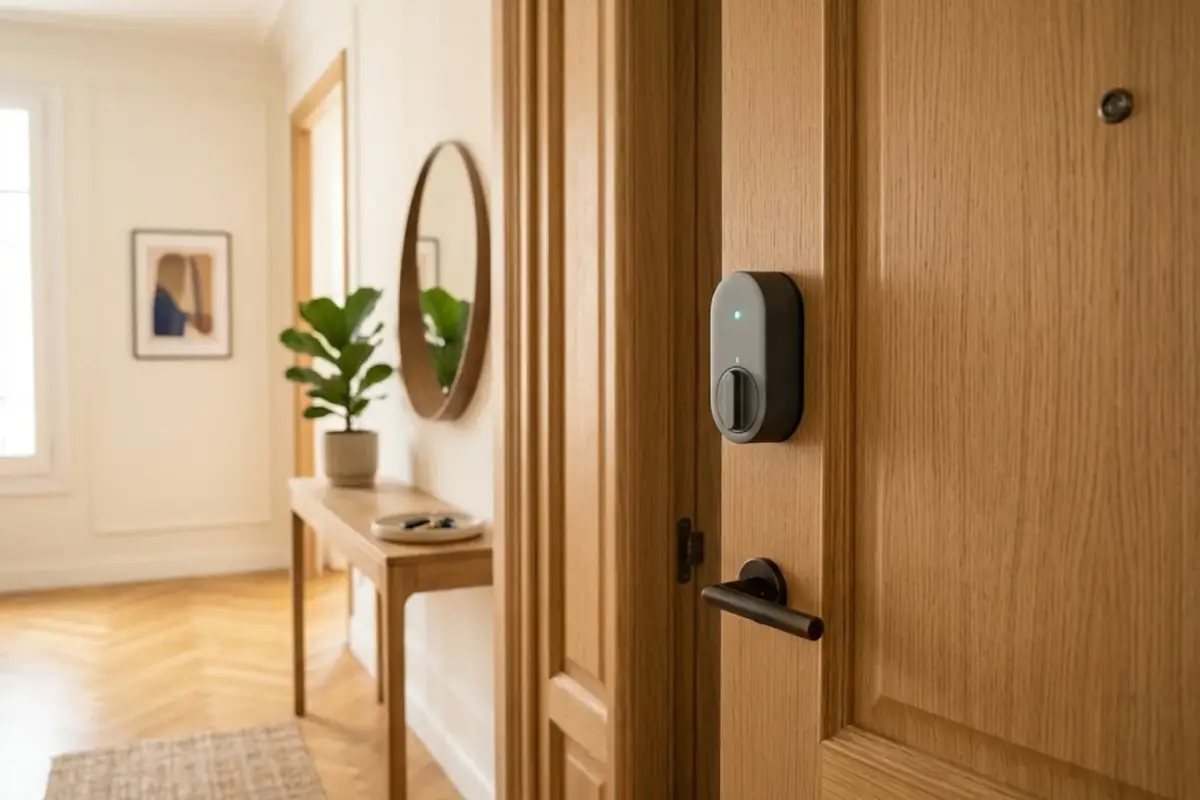
There's a question that always comes at the same moment: when someone has already decided they want to be rid of their keys and, just before buying anything, it occurs to them to look at their own door. “But will this fit mine?” It's the right question, and it comes in the right order.
The good news is that you can answer it without taking anything apart. Almost everything that decides whether your door can take a smart lock is visible from inside your home, and you can check it with a ruler and the set of keys in your pocket. Here's what to look at, in order of importance, and what each answer means. If what's holding you back isn't the fit but security, we deal with that separately in our piece on whether smart locks are safe.
First: look at your door from the inside, not the outside
The classic mistake is to judge the door from the landing. The smart lock we install by default doesn't touch the outside face: the motor mounts on the inside, over the cylinder you already have, and from the outside your door looks exactly as it did yesterday. That means the colour of the door leaf, the peephole or how nice the outside handle looks have no bearing on this decision.
What counts is what's on the inside face: which part of the cylinder is showing, how far it sticks out, and whether there's free space around it. Open the door, stand inside and take a good, unhurried look.
The cylinder: euro profile, double clutch and how far it sticks out
In Spain the standard is the euro profile cylinder, that mushroom-shaped piece that runs right through the lock from one side to the other. It's what nearly every flat door has, and it's what the motor grips on to. If on the inside you can see a keyhole with the recognisable euro profile shape, you're off to a good start.
Now for the two checks that really decide it. The first is how far the cylinder sticks out beyond the escutcheon or rose on the inside face. The module needs something to grip: if the cylinder sits flush or barely protrudes a millimetre, it needs replacing with a slightly longer one. Ten seconds with a ruler will tell you.
The second is the one that changes the most quotes, and the one almost nobody has heard of: the cylinder has to be double-clutch (doble embrague in Spanish) — also called an emergency function cylinder — meaning it can be opened from outside with a key left in on the inside. Because the motor permanently holds a key engaged on the inside face, an ordinary cylinder would make the door impossible to open from the landing. Many older cylinders aren't double-clutch. The test is simple and it's set out step by step in the list at the end.
A common and easy case: if instead of a keyhole on the inside you have a thumb turn or turning knob, there's no key to hold and the module grips the knob directly. It's usually the most convenient scenario of all.
How your door closes: just pulled shut, locked with the key or multipoint
A smart lock fitted over the cylinder does exactly what your key would do: turn. No more, no less. That has two very practical consequences.
First: if your door is simply pulled shut, held by the latch — that wedge that springs out as the door closes — the smart lock will draw back the deadbolt but won't push the door open for you. You'll still push the handle down to get in. It's worth knowing beforehand, because a lot of people expect the door to open by itself, and the only thing that does that is an electric strike in the frame, which is a separate installation.
Second: if you have a multipoint lock, the kind that hooks in at the top and bottom when you lift the handle, you need to check whether the points are driven by turning the key or by the handle itself. If the key drives them, you need a model with more motor torque; if they depend on lifting the handle by hand, the only part that can be automated is the deadbolt. Neither case is a “no”, but they change the model and the price.
Security, armoured, aluminium: what changes with each
These three words get used as if they meant the same thing, and they don't — and here the difference really matters.
A security door (puerta blindada) is a wooden leaf reinforced with sheet steel. It has a conventional lock with a euro profile cylinder, so in the vast majority of cases it takes the simple fit without any snags. It's the most common front door in Barcelona flats, and the answer is usually yes.
An armoured door (puerta acorazada) is a different thing: a steel block with its own frame, often with a lock and cylinder made by the door manufacturer itself, in a format of its own. If the cylinder is a standard euro profile, the lock is fitted just as on any other door. If it's proprietary, fitting over the cylinder won't work, and the honest route is that same manufacturer's motorised system, or leaving the lock as it is and automating the rest of the access. We tell you this during the visit, before anyone buys anything.
On narrow-profile aluminium or PVC doors — typical of a terrace door, a shop or a courtyard — the issue isn't compatibility but space: the cylinder sits in a very tight profile and the module may not have room. It's a matter of measuring.
And whichever of the three you have, check the six or seven centimetres around the cylinder on the inside face: a security chain, an extra bolt, a pull handle or a protruding frame can get in the way more than the type of door itself.
The building's street door is another story
It's worth separating the two doors, because the legal answer is different. The door to your flat is private property: you decide, and you don't have to ask anyone. The building's street door is common property, governed by Book Five of the Catalan Civil Code, the Codi civil de Catalunya (in Catalan) — not by Spain's national Horizontal Property Act (Ley de Propiedad Horizontal), which doesn't apply here — so changing its lock requires approval at a meeting of the owners' association (comunidad de propietarios).
In practice, what almost everyone wants from the street door isn't the lock but the ability to let in whoever's buzzing while they're away from home, and that's solved another way: by replacing the old intercom with a connected video door entry system, which you can do from inside your own flat. And if the owners' association also approves modernising access to the street door, the advantage is obvious: a code for each flat instead of dozens of copied keys circulating around the neighbourhood.
If you rent
This is where the technology shines, precisely because it leaves no trace. Fitting over the cylinder involves no drilling, no replaced parts and no changes to the door: it comes off in ten minutes and moves with you to your next home, like much of what we install with no building work of any kind. Meanwhile, your landlord's keys still open the door.
The exception is when the cylinder has to be swapped for a double-clutch one. That does mean modifying part of the property, and your landlord usually keeps a copy of the key, which would stop working. It gets discussed and sorted — normally by handing over copies of the new key — but it gets discussed first.
What if your door won't take the simple fit?
It's hardly ever a dead end: in most cases the solution is to replace the cylinder with a suitable one, of the right length and double-clutch. It's a cheap part of the overall job, and it's the natural moment to raise the door's security with anti-bump and anti-drill protection — something worth doing anyway if the cylinder has been in the door for fifteen years.
What does change is that it's no longer a reversible ten-minute fit, so if you rent, it needs discussing. A complete access control installation — lock fitted, configured and integrated into your local system — starts from €400. If the cylinder needs changing, you'll see it itemised in the quote, not as a surprise on installation day.
The five-minute check
With the door open, your keys and a ruler. In this order:
- Stand inside and look at the cylinder. Do you see a keyhole with the euro profile shape, or a thumb turn? Either will do; the thumb turn is the most convenient case.
- Measure how far the cylinder sticks out beyond the escutcheon on the inside face. If it's flush or protrudes by just a millimetre, make a note that it will probably need replacing.
- Test for double clutch. With the door open — this matters, so you don't lock yourself out — leave one key in on the inside and try turning another key from the outside. If it turns, perfect. If it won't go in or won't turn, your cylinder isn't double-clutch.
- Close the door and see how it stays shut. Is it just pulled shut? Do you have to turn the key? When you lift the handle, does it hook in at the top and bottom? Note down what you see.
- Check the free space in the six or seven centimetres around the cylinder, on the inside: chains, bolts, handles or mouldings that could get in the way.
With those five answers, it's already possible to tell over the phone, fairly accurately, whether your door takes the simple fit, needs a new cylinder, or is one of the rare cases that call for a different solution.
Common questions
How do I know if my cylinder is double-clutch?
With the door open, leave one key in on the inside and try turning another key from the outside. If it turns, your cylinder is double-clutch (also called an emergency function cylinder) and takes the simple fit. If the outside key won't go in or won't turn, it isn't: the cylinder would need replacing with one that is. It's the check that most often decides the quote, and the one almost nobody does before buying the device.
Can I fit a smart lock on an armoured door?
It depends on whether it has a standard lock or one made by the door's own manufacturer. Many armoured doors use an ordinary euro profile cylinder, and then the fit is the usual one. Others have a proprietary system, with a cylinder and keyhole in a format of their own, and there fitting over the cylinder doesn't work: the way forward is the motorised model that manufacturer offers, or living with the lock as it is and automating the rest of the access. A security door, which is a wooden leaf reinforced with sheet metal, usually has a conventional lock and poses no problem.
If my door is just pulled shut, will the smart lock still open it?
It unlocks it, but it won't push the door open for you. A model that fits over the cylinder turns exactly as far as your key would: it draws back the deadbolt, not the latch — the wedge-shaped piece that keeps the door caught in the frame when you close it. If your door is only ever pulled shut, you'll still push the handle down to get in. For the door to open by itself you need an electric strike in the frame, which is a separate installation.
Can I fit one on the building's street door?
On your own front door, yes, and you don't need anyone's permission. On the street door, no: it's common property of the owners' association, and changing its lock requires approval at an owners' meeting. What can usually be solved without touching the street door is letting visitors in, by upgrading the intercom. If the owners do agree, it's installed the same way and each flat gets its own code instead of copies of the key.
I rent. Do I need my landlord's permission?
For the fit over the existing cylinder, in practice you're not changing anything about the property: there's no drilling, no part is replaced and your keys work exactly as before. It comes off in ten minutes and you take it with you to your next home. It's a different matter if the cylinder has to be changed: then you are modifying part of the property, and it's best to talk it over with your landlord, who usually keeps a copy of the key as well. Our advice is to always tell them, even though the installation is reversible.
In short
Whether a smart lock fits isn't decided by the brand of the device or by how modern your door is: it's decided by three things right in front of you — which cylinder you have, how the door locks and how much space there is on the inside. Most flat doors in Barcelona take the simple fit just as they are, and of those that don't, almost all are sorted by changing a part that costs a few euros. Before you choose a model, measure your door: it's the step everyone skips, and the one that saves you from buying a device that then doesn't fit.