
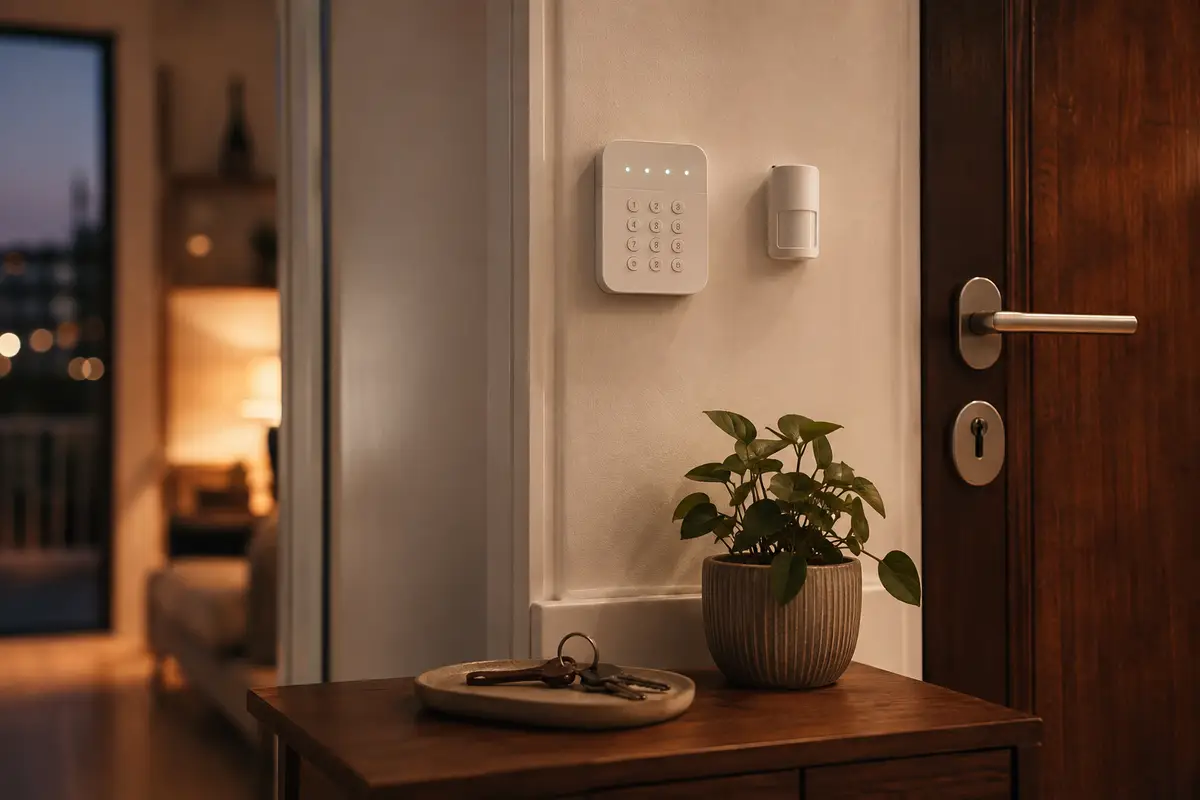
It's a scene we see on a lot of visits: there's an alarm keypad in the hallway with a very recognisable sticker and, as soon as the subject comes up, the line is almost always the same — “between what I pay every month and the minimum term they made me sign…”. The monthly-fee alarm is the model everyone knows, because it's the one advertised on TV. What hardly anyone knows is that the opposite model exists: you pay for the equipment once, it's yours, and you never pay anything again.
Neither is a scam or a miracle: they're two different products that look alike from the outside. What follows puts the numbers for each on the table — the ones in the adverts and the ones that aren't — along with an honest explanation of what an alarm receiving centre really adds, and who each model is worth it for.
What you really pay with a monthly-fee alarm
The sales model is a well-oiled machine: the installation is advertised as cheap, or even free “as a special offer”, because that's not where the business is — it's in the monthly fee. The going rate on the market is between €30 and €50 a month, with a 24- or 36-month minimum-term contract underneath.
It's worth doing the maths slowly, because small monthly payments never feel like real money: at €40 a month, that's €480 a year. €2,400 over five years, €4,800 over ten, plus the sign-up fee. And there's a detail in the contract that many people only discover the day they want to cancel: in most cases the equipment isn't yours. It's lent to you while you pay; when you stop paying, the company takes it away or it gets locked, because it can only talk to that company's receiving centre. After ten years and almost five thousand euros, your wall is left exactly as it was.
In exchange for that fee there is a real service, and we're not going to caricature it: a centre staffed by people 24 hours a day that verifies every activation and, where appropriate, alerts the police. How much that's worth — and to whom — is exactly the question the rest of this article answers.
What an alarm with no monthly fees is (and exactly what it includes)
An alarm with no monthly fees is, above all, equipment you own: contact sensors on the door and windows, motion detectors, an indoor siren and, if you want them, cameras. You pay once — our security systems start from €900, installation and configuration included — and there's no monthly fee, no minimum term and no small print tying you to anyone.
When something is triggered, the alert reaches your phone, and the phones of whoever you choose, within seconds, with the photo or clip from the relevant camera, so you can see straight away whether it was the cat or whether there's someone in your living room. The footage is stored locally, inside your home, not on a company's server: nobody else can see your living room, and the whole system runs on your own network, following the same philosophy as the rest of the cloud-free home automation we install.
And there's a third difference, less obvious than the money: a monthly-fee alarm is a closed system that does nothing but act as an alarm. One with no monthly fees, built on your home's system, is just another part of your home automation: the same motion detectors that set it off in the small hours are the ones that switch on the hallway light on any ordinary Tuesday. We'll come back to this shortly, because it's where the whole approach really changes.
The alarm receiving centre: the one thing an alarm with no monthly fees doesn't give you
Here's the part that one side's advertising leaves out and the other side's exaggerates. What you're really buying with the monthly fee isn't the sensors — they're equivalent to those of any other system — but the alarm receiving centre: a control room staffed by people 24 hours a day that receives the activation, verifies it by video or audio and, where appropriate, passes the alert on to the police.
That last step isn't legal window dressing: Spain's private security legislation — Law 5/2014 (in Spanish) — reserves the reporting of alarm activations to the police for officially approved receiving centres, precisely to filter out false alarms. A private individual doesn't have that direct channel: if your alarm goes off and you see someone on the camera, you call 112 like any other witness. The call is handled just the same; the difference is who makes it — and that the centre makes it even if you're on a plane with your phone switched off.
So the honest question isn't “receiving centre: yes or no?”, but: what happens in your particular case in the minutes after an activation? If you live in the flat, with your phone on you and neighbours on the other side of the wall, a video alert in your hand deals with the situation just as well — or sooner, because there's no verification step in between. If the alarm protects a second home two hours' drive away where nobody can pop round to check, having someone keep watch for you has real value, and to deny it would be selling snake oil.
The two side by side: the table
| Monthly-fee alarm | Alarm with no monthly fees | |
|---|---|---|
| Upfront payment | Sign-up fee and installation, often “on special offer” | Equipment and installation, from €900 |
| Monthly fee | Typically between €30 and €50 | €0 |
| Cost over 5 years | Around €2,400 in fees alone (at €40/month) | The upfront payment, and that's it |
| The equipment | The company's: lent to you while you pay | Yours |
| Minimum term | Typically 24–36 months | None |
| Who gets the alert | The receiving centre, 24/7 | Your phone and those of whoever you choose, with images |
| Alerting the police | The centre does it after verifying | You do it, by calling 112 |
| The footage | Usually in the provider's cloud | Locally, in your home |
| If you stop paying | They remove or lock the equipment | There's nothing to stop paying |
| With the rest of the home | Closed system: alarm only | Integrates: lights, blinds, presence simulation |
When each one is worth it (really)
With the table in front of you, the profiles pretty much sort themselves out. The monthly-fee alarm, with its receiving centre, makes sense when nobody can respond to the alert:
- An isolated second home, hours away, where neither you nor any neighbour can go round to check anything.
- People who don't want to depend on their phone: some people simply won't look at a notification, and they know it.
- A business whose insurance requires a connection to an alarm receiving centre — it's written into some commercial policies; read yours before you decide.
The alarm with no monthly fees wins in what turns out to be the most common case:
- Your main home, with your phone always on you and neighbours on the other side of the wall: the video alert reaches you before any verification protocol would.
- Rented flats: no minimum term and no building work; the equipment is yours and comes with you when you move.
- Anyone who already has — or wants — home automation: the alarm becomes one more part of the system, not a separate gadget with its own app and its own bill.
- Anyone who doesn't want their cameras in somebody else's cloud: with local recording, the footage of your home never leaves your home — which cameras work and where they're allowed to point is covered in our guide to home security cameras with no monthly fee.
How we set it up
Our security systems run on your home's platform — Home Assistant, on your local network — with contact and motion sensors, a siren, cameras with local recording and alerts on the whole family's phones. It arms by zone: night mode watches the door, windows and terrace while you're all asleep inside, without a trip to the bathroom waking anyone up.
And because the alarm lives inside your home automation, the whole house pitches in. If something is triggered in the small hours, it isn't just the siren that goes off: the lights around the house come on at the same time, which throws an intruder far more than a beep does. The same system also keeps an eye on water, with leak sensors that warn you before a drip turns into a flood, and when you go away on holiday the house simulates presence with lights and blinds so that, with any luck, the alarm never has to go off at all. All for a single payment from €900 — and we guarantee our installation and configuration for 5 years.
Common questions
Is it legal to have an alarm that isn't connected to a receiving centre?
Yes, completely. The law regulates alarms connected to an alarm receiving centre — who can provide that service and how each activation must be verified — but a system that alerts you on your own phone is simply equipment for home use, like a doorbell or a camera: it needs no contract, no certification and no permit. The only real limit is that direct communication with the police is reserved for officially approved receiving centres; if your alarm goes off and you see someone inside your home on the camera, you call 112 like any other witness, and that call is handled in exactly the same way.
What happens if there's a power cut or the internet goes down?
The sensors run on batteries — which last for years — and the system's hub has a backup battery, so a power cut doesn't switch it off. Without the internet, everything that happens inside the house keeps working: the siren sounds and local recording carries on; what you lose for as long as the outage lasts is the alert to your phone, because that alert travels over the internet. In homes where that gap is a concern — a second home, for example — a router with a backup data SIM is added and the alert goes out over the mobile network.
I have a monthly-fee alarm: can I keep the equipment and stop paying?
Almost never. In most contracts the equipment isn't sold to you: it's lent to you while you pay the fee, so when you cancel, the company takes it away or it becomes useless, because it can only talk to that company's receiving centre. The sensible thing is to check first when your minimum term ends — it's usually 24 or 36 months — and make the switch from then on: the new installation is fitted in a morning and doesn't reuse anything from the old equipment, so there's nothing to coordinate with the cancellation.
How much does an alarm with no monthly fees cost?
From €900, installation and configuration included, as a one-off payment: no monthly fees and no minimum term. From there, the price depends on the number of sensors and cameras and on whether it's integrated with more home automation — lights, blinds, presence simulation. The visit and the quote are no-obligation, and we guarantee our installation and configuration for 5 years.
In short
A monthly-fee alarm and one with no monthly fees look alike from the outside, but they sell different things: the first charges you every month for a centre that keeps watch for you — and that's worth it precisely when nobody else can respond to the alert; the second is yours, alerts your phone with images, keeps the recordings at home and never costs you money again. For a main home, with your phone on you and your home automation working on the same equipment, the maths almost always comes out on the same side: the €2,400 a monthly fee takes over five years is enough to protect the whole house with a single payment — and for it all to be yours.