
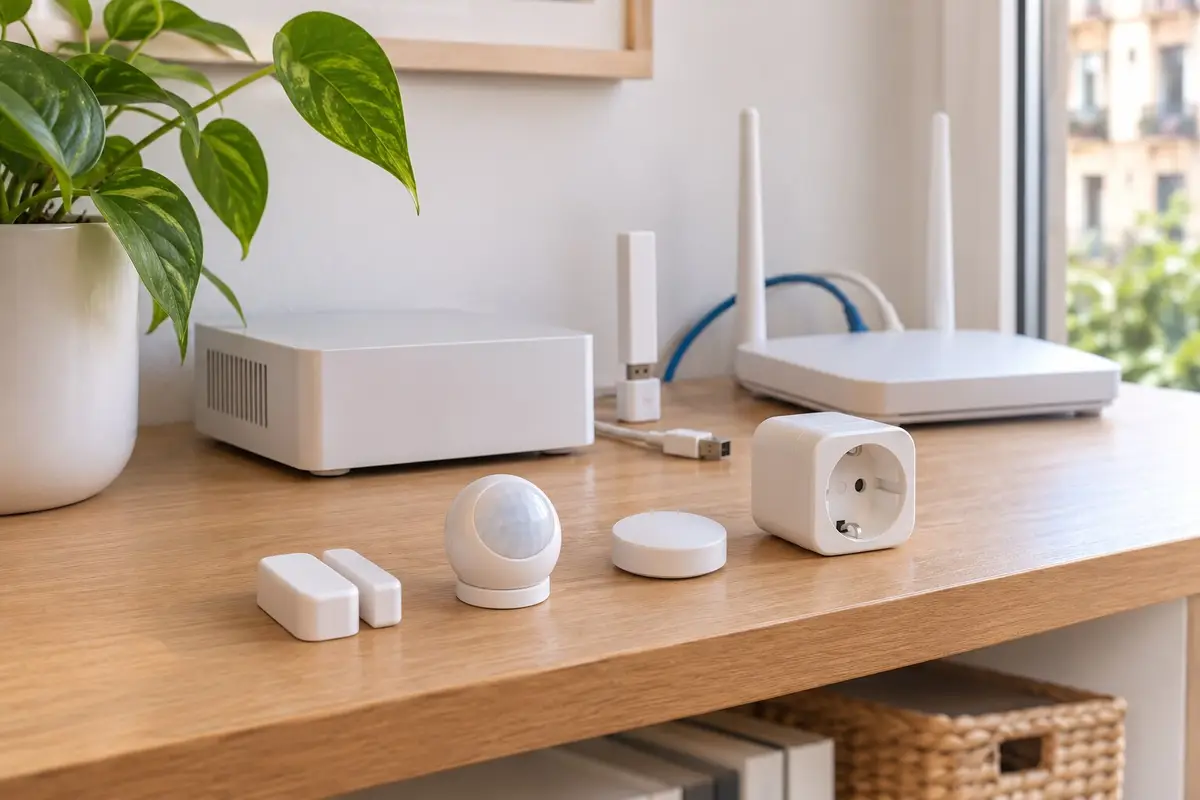
The box of every smart home device says something: Zigbee, Z-Wave, Wi-Fi, Matter, Thread or “works with Alexa”. Every shop recommends something different, and people starting out end up with a plug from one brand, bulbs from another and three apps on their phone that don't talk to each other.
The acronym matters less than it seems. What really decides whether a device fits your home are three questions, and in a well-built home several protocols coexist without you having to think about them. This guide explains what each one is, what it's for and what we fit for each device.
The three questions that matter
- Does it work without the internet? If a device needs its manufacturer's cloud to switch on a light, it stops working the day the internet fails, or the brand shuts down the service.
- Does it use little power? A door or motion sensor runs on a battery. If the protocol uses a lot, you'll be changing batteries every few months; if it uses little, a coin cell lasts years.
- Does it get on with everything else? What you have today and what you add in two years' time must work in the same system, even if it's from another brand.
Zigbee: the backbone of almost everything
It's what we fit in almost every device in a home: sensors, buttons, plugs and bulbs. Zigbee forms its own radio network, separate from Wi-Fi, so it doesn't load it and isn't affected when you restart the router. It uses very little power, which is why sensors last years on a battery, and it works locally, without going through the internet. It's also the protocol with the widest choice of devices and brands.
Its network is a mesh: whatever is plugged into the mains, such as plugs, bulbs or relays, acts as a repeater for the battery-powered sensors. The more plugged-in devices, the stronger the network. The flip side is that if someone unplugs one of those repeaters, the sensors in that area can lose coverage. And as Zigbee and Wi-Fi share the 2.4 GHz band, we choose channels that don't clash.
Z-Wave: for specific cases
Z-Wave is also its own low-power mesh radio network, but it runs on another band, away from Wi-Fi's. That gives it less interference and longer range. We use it in specific cases: large homes or homes with thick walls, where the signal has to travel far; buildings where the 2.4 GHz band is crowded with neighbours' networks; and devices that only come in Z-Wave.
Wi-Fi: for what needs bandwidth
Wi-Fi makes sense for things that move a lot of data or are always plugged in: cameras, above all, and some light relays, which we fit on Wi-Fi or Zigbee depending on the home. It has two catches. First, many cheap Wi-Fi devices only work through their manufacturer's cloud. Second, dozens of devices on the Wi-Fi can overload a home router. That's why the ones we fit work locally, and we don't fill the Wi-Fi with sensors.
Matter and Thread: the new standard
Matter isn't a radio but a common language: a device with the Matter logo works with Alexa, Google Home and Apple's Home app without going through its manufacturer's app. Thread is the radio it usually uses, a low-power mesh similar to Zigbee. We already fit it where it suits, but Matter is advancing device by device and doesn't cover them all yet. We go into more detail in a smart home that works with Alexa, Google Home and HomeKit.
Can they be mixed? Yes, and that's normal
In a well-built home several protocols coexist, and you don't notice: everything goes into one system, with one app and the same automations. That system is Home Assistant, a small server that stays in your home and talks to all of them at once. How each protocol connects, with its antenna, is explained in what Home Assistant is. If you'd like us to set it up, or review the one you already have, see our Home Assistant installation page.
The home's radio networks also repair themselves: after a power cut, the mesh forms again and the battery-powered sensors, which never switched off, start reporting again. What else happens in that case is covered in what happens to home automation in a power cut.
Device by device
- Door, motion, temperature and water leak sensors: Zigbee, on batteries.
- Buttons: Zigbee.
- Plugs and bulbs: Zigbee, and they also act as repeaters for the sensors.
- Light relays: Wi-Fi or Zigbee, depending on the home.
- Cameras: Wi-Fi or cable.
- Large homes or tricky signal: Z-Wave where needed.
- New devices with the Matter logo: yes, when they fit in with the rest.
We don't give a figure here, because it depends on what you have and what you want to add. We quote for it during the visit, with no obligation, as a one-off payment with no monthly fees. It comes with the same warranty as everything else we install: we guarantee our installation and configuration for 5 years. The devices carry their manufacturer's warranty (2–3 years), and we handle it for you.
Common questions
Does it work if the internet goes down?
Whatever runs on Zigbee, Z-Wave or Thread does: those networks belong to the home and don't go through the internet. Wi-Fi devices also keep working if they're controlled locally, without the manufacturer's cloud, which is how we set them up. What does need the internet is whatever lives outside the home, such as Alexa's voice or alerts to your phone when you're out.
Can I reuse what I already have?
If it's compatible, yes: we integrate it into the same system as the new devices, whether it's Zigbee, Z-Wave, Wi-Fi or Matter. What can't be reused is anything that only works with its own app and its own cloud, and we tell you that during the visit, before the quote.
Do I need a hub from each brand?
No. For Zigbee, Z-Wave and Thread, an antenna plugged into the small home server is enough, and we fit it. That same server also talks to Wi-Fi and Matter devices, so everything stays in one system and one app.
Will Matter replace Zigbee?
Today they coexist, and what's installed today keeps working. Matter is growing device by device and we already fit it where it suits, but it doesn't cover everything yet. That's why the backbone of the home is still Zigbee, which has been solving exactly this for years.
How long does a sensor battery last?
With Zigbee, Z-Wave or Thread, years, on a coin cell: those networks are designed to use very little power. A battery-powered Wi-Fi sensor uses quite a lot more, which is why we hardly ever put sensors on Wi-Fi.
In short
No single protocol solves everything, and it doesn't need to. Zigbee for almost everything, Z-Wave where the signal calls for it, Wi-Fi for cameras and whatever needs bandwidth, and Matter where it fits, all in one system that works without the internet. The question isn't which acronym is on the box, but whether the device will still work in your home in five years' time.