
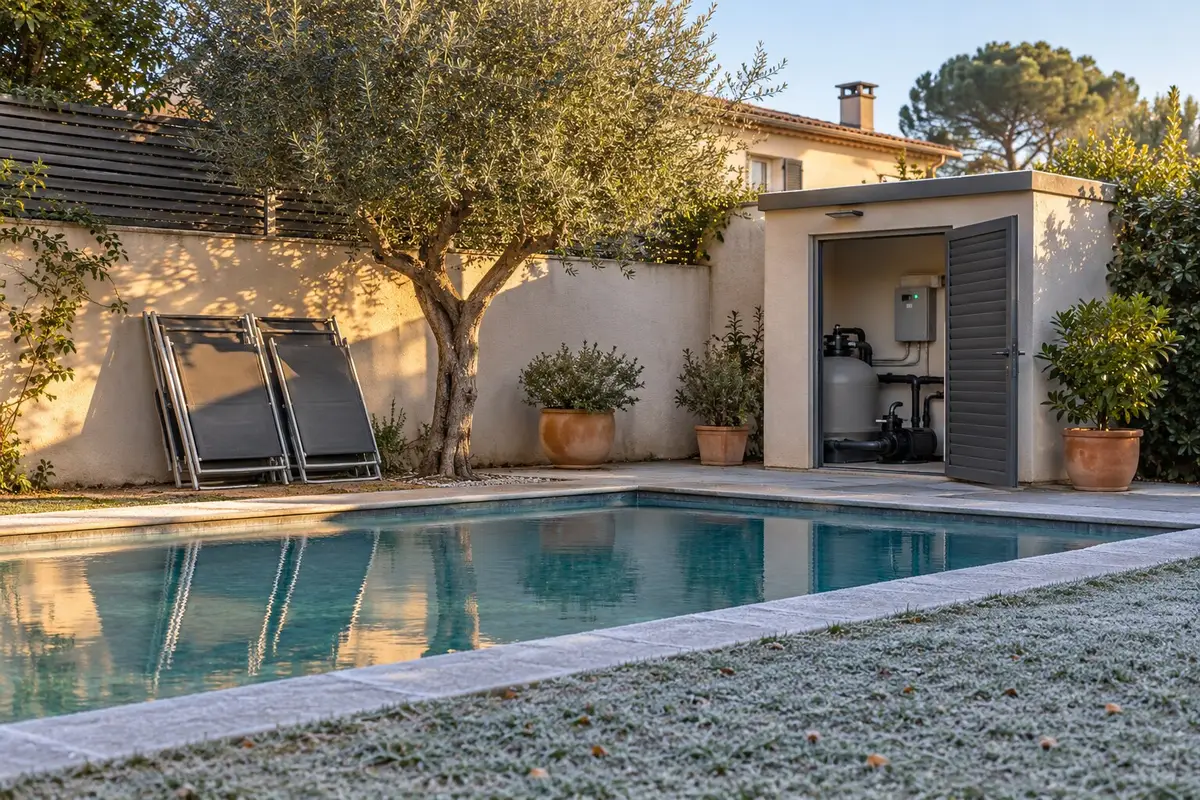
In November nobody swims any more, but the pool is still there, and you have to decide what to do with it until May. Usually it's one of two things: the pump carries on with the August schedule, eight or ten hours a day for nobody, or someone switches it off “until spring” and by March the water is green.
In a mild climate, the usual answer is somewhere in between: the pump keeps filtering a little every day. And that's exactly what your home can handle by itself, without anyone touching the timer: when to start, how many hours, at what time and what to do if there's going to be a frost one night.
Active or passive winterising: what changes
There are two ways to get through the winter. With active winterising, the pump keeps running a few hours a day and the water stays at its level, so in spring it's clean and ready to use again straight away. With passive winterising, the pump is switched off completely and the system is prepared to sit idle for months: the pipes are drained, plugs are fitted and a winterising product goes in.
The winterising guide by Bayrol (in Spanish), a maker of pool products, sums it up like this: active suits places with mild winters and little risk of frost, and passive suits places where it's cold and frosts often. The product, the plugs and preparing a passive winterisation are a job for your pool technician, or for you. What your home can handle by itself is active winterising: the pump, the frost and the alerts.
When to switch to winter mode: your home suggests it
You don't need to watch the calendar. Your home logs the water temperature every day and, when it has been below 15 °C for three days, you get an alert on your phone with a button to switch to winter mode. That's roughly when Bayrol's guide calls an end to the swimming season: with the water between 20 and 15 °C, and below 15 °C, well into winter.
In spring the same happens in reverse: with the water at 17 °C or more for three days, it suggests going back to normal filtering. And so as not to nag, it never suggests it more than once every two weeks.
How many hours, and when
In winter mode, the pump filters two hours a day by default, regardless of the water temperature. You can change that in your home's settings: Bayrol's guide talks about at least two hours with active winterising and four at times of higher frost risk, so if your pool technician asks for more, you set more.
The interesting part is when. Your home spreads those hours in one of three ways, whichever you choose:
- In time slots, within the hours you set.
- In the cheapest hours of the day, if you're on a time-of-use tariff. They tend to fall in the early hours, which is exactly when it's coldest and when the water most needs to keep moving. How those hours work is covered in your electricity bill and off-peak hours.
- With spare solar power, if you have panels: it filters when the panels produce more than the home is using and, if it gets late, it finishes the hours anyway.
Frosty nights
The real winter risk is water sitting still in the pipes on a frosty night. That's what frost protection is for, and it comes switched on: if the water or the air drops below 2 °C, your home starts the pump, even if it isn't due and even if automatic filtering is off, and keeps it running until both are back above 3 °C. The air temperature comes from a sensor at home or, if there isn't one, from the weather forecast.
The same applies to the garden: how to protect your watering system from the cold is covered in automatic watering in autumn. And an honest caveat: without power nothing starts, the pump included. What your home does do is start up again by itself when the power comes back, as we explain in what happens to home automation in a power cut.
What stops bothering you (and what doesn't)
Some things don't matter in winter, and your home stops alerting you about them. It doesn't alert you about the water chemistry or send you the Sunday summary. The robotic pool cleaner doesn't clean by itself. Of the maintenance, it only reminds you to clean the filter, counted by hours of pumping rather than by days. And the “good morning” summary stops telling you the water temperature.
What it does keep alerting you about is what could prove expensive: if the pump doesn't start, stops responding or uses much more or much less power than usual. And, if the pool has a level sensor, if the water drops too much, which could be a leak, or rises with the rain.
What if you fancy a swim in January?
If the pool has a heat pump, winter mode won't stop you. With “Ready by” you choose the day and time, say Saturday at noon, and your home heats the water just as much as needed beforehand, even in winter mode. It learns how much the water warms each hour, so it gets better every time at knowing when to start.
What you need (and how we quote for it)
The essentials are few: the pump connected with a relay or a smart plug and a probe that measures the water temperature. We connect them during the installation. If you also have a time-of-use tariff, solar panels, a heat pump, a level sensor or a robotic pool cleaner, they're put to use. And what it does in winter it also does in summer, with the hours the heat calls for and the rest of the garden, as we explain in smart irrigation and garden.
We don't give a fixed figure here, because it depends on what your pool already has and what you want it to do. We quote for it during the visit, with no obligation, as a one-off payment with no monthly fees. It comes with the same warranty as everything else we install: we guarantee our installation and configuration for 5 years. The devices carry their manufacturer's warranty (2–3 years), and we handle it for you.
Common questions
Do I need to drain the pool for the winter?
Usually not, and it isn't something home automation decides. The water protects the pool shell and, in a mild climate, the usual approach is to leave it full and keep the pump filtering a little. If you have doubts about your pool, ask your pool technician.
Can I switch the pump off for the whole winter?
Yes, if you do a passive winterisation: the system is prepared to spend the winter switched off, with its winterising product, its plugs and the pipes drained. Your pool technician does that, or you do. If it isn't prepared that way, it's better for the pump to keep filtering a few hours a day.
Will it still alert me to anything in the winter?
Yes, to what matters. If the pump doesn't start, stops responding or uses much more or much less power than usual, you get an alert on your phone. And if the pool has a level sensor, it also alerts you if the water drops too much, which could be a leak.
Does it work if my pump already has its own timer?
Yes. During the installation we connect the pump so your home controls it, with a relay or a smart plug, and from then on the system decides the hours. We look at it during the visit with your pump.
And in the spring?
The same in reverse: when the water has been at 17 °C or more for three days, your home suggests going back to normal filtering, which works out the hours from the water temperature. All you have to do is tap the button on the alert.
In short
A pool in winter doesn't need eight hours of pumping, nor does it need to sit idle without being prepared. With active winterising, your home suggests winter mode when the water cools down, filters a few hours in the cheapest ones and starts the pump if there's going to be a frost. For everything else, it only alerts you if something goes wrong. In winter, the best thing about the pool is not having to think about it.