
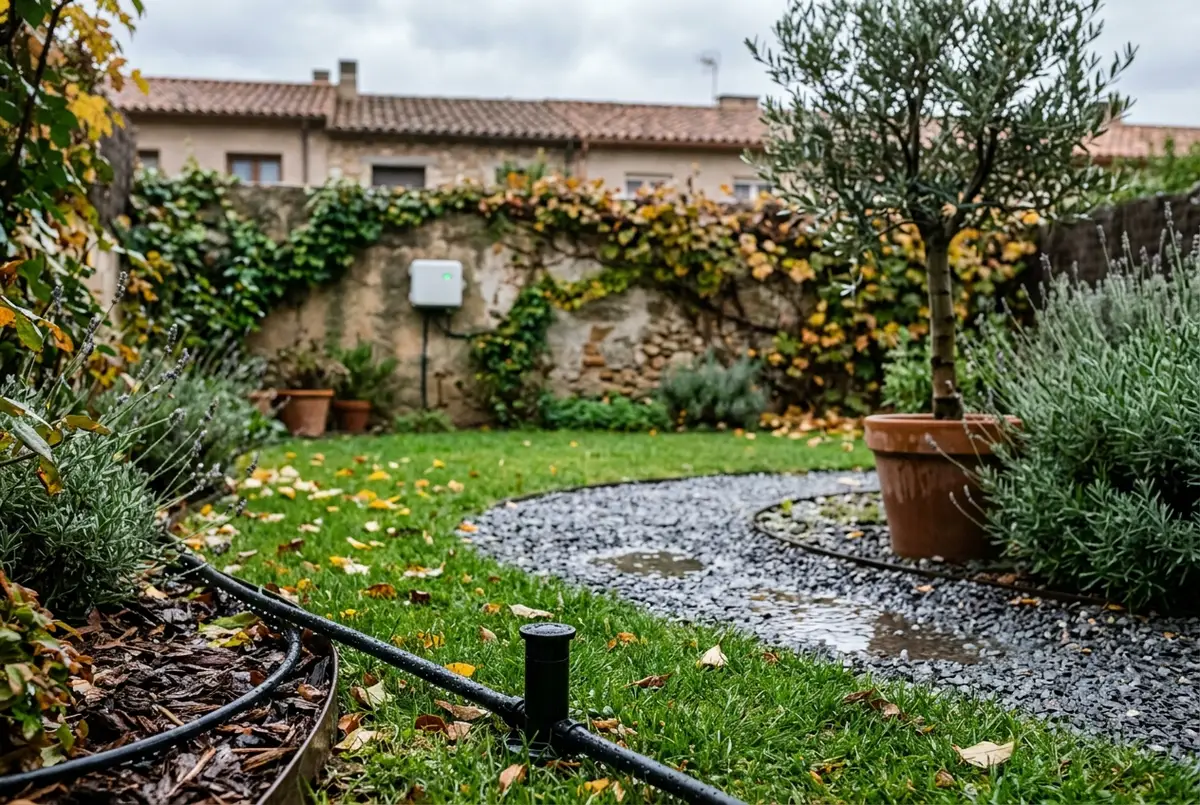
It's a very October scene. It has rained all night, the lawn is waterlogged, the path is full of puddles, and at seven in the morning the sprinkler comes on for its usual twenty minutes. Nobody has touched it since August, so it's still watering as if it were August. And October is the exact opposite: according to the climate normals from AEMET, Spain's state meteorological agency, for Barcelona airport, it's the wettest month of the year, with an average of 91 litres per square metre spread over around six rainy days. July gets 21. October on its own gets more rain than July and August put together.
The programme that worked in August is too much in October. The garden needs far less water and the sky provides a good part of it. Watering that takes no notice of either wastes water and, worse, waterlogs the roots just when they find it hardest to dry out. This guide is about what changes when it turns cold: how to skip autumn rain, how to scale back the watering without reprogramming zone by zone, what to do when it freezes and how to get the system ready for winter.
Why summer watering is too much in autumn
In summer, most of the water you give the garden isn't kept by the plants: it goes into the air, through soil drying in the sun and through leaves transpiring in the heat. That loss — evapotranspiration — is what sets how much needs replacing, and it depends mainly on sun, temperature and wind. By October the days are noticeably shorter, the sun is lower and the nights are cooler, so the soil takes much longer to dry out.
Then there are the plants themselves. Many slow down in the cool: they stop putting out new shoots, deciduous shrubs lose their leaves and whatever stays green uses far less. They still need water, but a good deal less. A programme designed to replace what's lost in a week of August, applied unchanged in November, overwaters almost every day.
And overwatering does more harm in autumn than in summer. In August, the extra water evaporates within a couple of days; in November, it stays. Soil that's waterlogged for weeks on end is a breeding ground for root fungi, and it's the quietest way to lose a hedge that looked perfect all summer.
Skipping autumn rain
We covered the basics in our guide to watering while you're on holiday: the three signals that stop you watering after rain are the rain sensor, the weather forecast and the soil moisture sensor, and the rule that ties them together is "don't water if the soil is still damp or if rain is coming". In autumn that rule still holds, but the rain behaves differently, and it's worth fine-tuning it on three points.
It's not whether it rained, but how much
Autumn rain in Barcelona often comes as short, heavy storms: half an hour that turns the street into a river, followed by days of sunshine. A simple rain sensor only knows whether it's raining, and to it a ten-minute drizzle and a downpour that soaks the ground are the same thing. What really matters is how much has fallen. With a rain gauge in the garden, or the reading from the nearest weather station, the watering skips one day after a drizzle and several after a downpour. And the soil moisture sensor decides when it resumes: when the soil is dry again, not when the calendar says so.
The forecast as a warning, not the boss
The forecast brings the other big saving: if a day of rain is forecast, there's no point watering the day before. In Home Assistant, the system we work with, it comes from the official AEMET integration, which gives daily and hourly forecasts with the chance of rain. But storm forecasts are often wrong — the rain falls on the next neighbourhood, or doesn't fall at all — so the forecast only postpones: if it hasn't rained by the next day and the sensor says the soil is dry, the garden gets watered. And because it comes over the internet, it's never the only signal. The garden's programmes and sensors run locally, so if your fibre goes down, the watering keeps deciding based on what it measures at home.
Where the rain doesn't reach
The detail almost everyone overlooks: when it rains, not all of the garden gets wet. Pots under the overhang of a terrace, planters against the façade or a covered porch can go through a week of rain bone dry. If rain cancels the watering for the whole house, those plants go without water just when nobody is thinking about them. That's why the rain pause is set per zone: the lawn and open beds skip their watering, and the covered zone carries on with its own moisture sensor as if nothing had happened.
Adjusting for the season without reprogramming every zone
Reprogramming every zone by hand whenever the weather changes is exactly what nobody does, which is why so many gardens get watered in November as if it were August. The alternative is a seasonal adjustment. The summer programme stays as the reference and the system applies a percentage depending on the time of year — fewer, shorter waterings in autumn, fewer still in winter — or, better, based on each week's actual weather: the temperature, sunshine and rainfall of the last few days. A week of late heat in October gets a bit more water; a grey week in November, hardly any. And in spring the same adjustment goes back up on its own, without anyone having to remember to reprogramme it.
The time of day changes too. In summer it's best to water before dawn, so the water doesn't evaporate before it reaches the roots. In winter that reason disappears, because hardly anything evaporates, and another appears for waiting: after a cold night, water struggles to soak into frozen soil, and whatever is left in exposed drippers and pipes can freeze. So in the cold months we move the watering to mid-morning, once the temperature has risen.
When it freezes
On the coast it hardly happens: at Barcelona airport, AEMET records fewer than four frost days a year on average, nearly all between December and February. But you only need to go a few kilometres inland — the Vallès, a house in the Montseny or the Pyrenees — for frost to stop being a rarity. And watering in a frost is a bad idea twice over: the water can't get into frozen soil and sits on top as a layer of ice, and the water left inside drippers, valves and exposed pipes expands as it freezes and can split them.
The answer is an outdoor temperature sensor, in the shade and close to the ground, that cuts off the watering below about 3 °C and won't let it start until the temperature recovers. It's the same idea that already protects the indoor pipes in a second home that's shut up for the winter: the house keeps an eye on the cold even when nobody is there, and lets you know if something doesn't add up.
Getting the watering ready for winter
Before the first frosts it's worth going over the system. There are two parts: what the system does, and the physical part, which falls to whoever looks after the garden.
What the system does
- Winter mode. A schedule with few waterings, mid-morning, that still skips the rain and does what the moisture sensor says.
- Frost cut-off. Below about 3 °C there's no watering, and you get an alert when it kicks in.
- An alert if the flow doesn't add up. With a flow sensor, the system knows how much water should pass in each watering. If much more goes through, there's a broken pipe or a loose dripper; if nothing does, the filter is blocked or the valve is closed. In winter it's how you find out about a pipe burst by the cold before the bill arrives.
- Pause from your phone. For a week of forecast rain or while work is being done in the garden, with an automatic return to the schedule.
The physical part (you or your gardener)
- Drain the drippers and any pipes left out in the open, especially where it freezes: the water left inside is what bursts them.
- Clean the filter on the circuit. After a whole summer it's usually dirty, and it's the most common reason the last plants on the line get less water.
- Take off the battery tap timer, if you have one, remove the batteries and store it indoors: it isn't designed to sit out through frosts, and forgotten batteries end up damaging the contacts.
- Protect outdoor taps and the watering valve if they're exposed: a tap that freezes with water inside can crack.
If your garden is on the coast and doesn't get frost, the physical part comes down to little more than cleaning the filter. If it's inland, or it's a house that's closed up for the winter, it's worth doing all of it.
What you need (and what it costs)
If you already have a watering system, nearly all of it can be reused: the pipes, drippers and zone valves stay. What changes is the controller, which becomes part of your home's system, and the sensors are added: rain, soil moisture per zone, temperature and, if you want leak alerts, flow. That's how smart watering that adapts to every season works: the same system that skips the rain in October protects itself from frost in January and goes back to the summer programme on its own in May.
A basic installation — a connected controller plus a rain or moisture sensor — starts from €300. Zoned watering with more sensors is quoted during the visit, with no obligation, as a one-off payment with no monthly fees. It comes with the same warranty as everything else we install: we guarantee our installation and configuration for 5 years. The devices carry their manufacturer's warranty (2–3 years), and we handle it for you.
Common questions
Should I switch off automatic watering in winter?
Completely, hardly ever. What makes sense is moving it to a winter schedule, with far fewer waterings, and letting the rain and the soil moisture decide the rest: young trees, hedges and above all the pots on a covered terrace still need water during dry spells, and Barcelona has those in January too. Shutting it down entirely, and draining the system, only makes sense in a garden that gets proper frosts or in a house that stays closed all winter.
How often should I water in autumn and winter?
Much less than in summer, but there's no figure that works for every garden: it depends on the soil, the plant, which way it faces and whether it has rained. That's why it's better to let a soil moisture sensor decide rather than a fixed schedule. The programme proposes a watering and the sensor confirms or cancels it: if the soil is still damp, there's no watering that day, and the pace adjusts itself week by week.
What happens if the forecast is wrong or the internet goes down?
The weather forecast comes over the internet and is sometimes wrong, so it never decides on its own. If your fibre goes down, the watering doesn't stop: the programmes and the rain, soil moisture and temperature sensors run locally, on the device in your home, and keep deciding whether it's time to water. All you lose in the meantime is the forecast for the coming days and the alerts on your phone.
Can I pause the watering from my phone?
Yes. You can pause it for a few days — for example when a week of rain is forecast, or while the gardener is working on a bed — and it goes back to its schedule on its own when the pause ends. You can also run a watering by hand in a single zone. And whenever the system skips a watering because of rain or frost, you get an alert with the reason, so you're not left wondering why it didn't water.
How much does watering that adapts to the season cost?
A basic installation — a connected controller plus a rain or moisture sensor — starts from €300. With that, the watering already skips rainy days and can switch to a winter schedule. Zoned watering, with a moisture sensor in each bed and a frost cut-off, is quoted according to the area and the number of circuits, with a free, no-obligation visit. If you already have a watering system, most of the work is replacing the controller and adding the sensors.
In short
In autumn the garden asks for less water and the sky provides a good share of it, so August's watering, left as it is, overshoots. Watering that measures how much rain has fallen and not just whether it has rained, treats covered zones separately, scales back on its own with the season, won't start in a frost and tells you if a pipe breaks looks after itself almost without you thinking about it. The physical part — draining whatever is left out in the open and putting the tap timer away — takes half an hour before the first frosts. In autumn, the best automatic watering is the one that knows when not to water.