
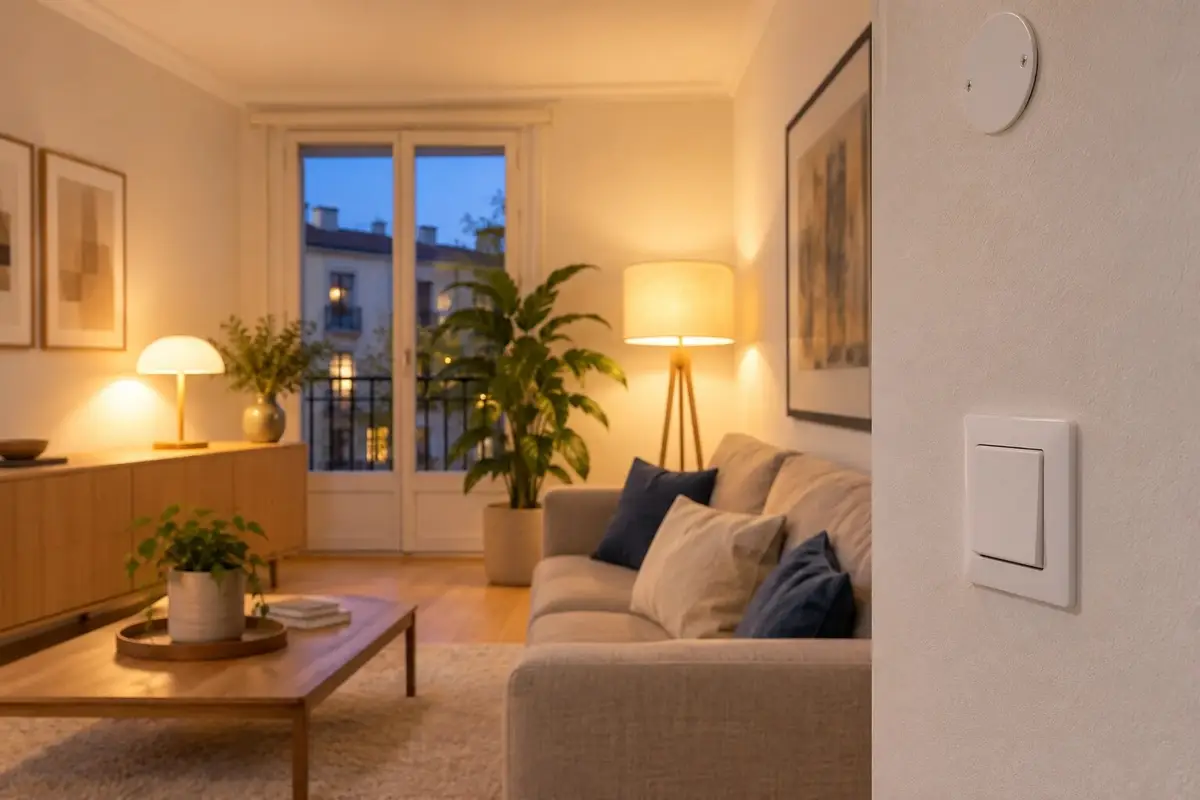
It's almost everyone's first question when they want to control the lights at home from their phone: do I change the bulbs or fit something in the wiring? The bulb looks like the easy option, because you just screw it in. And it works, until the day someone at home, or a guest, switches the light off at the wall out of sheer habit.
The short answer is that most lights in a home are better with a relay in the wiring, which keeps your usual switch and works with any bulb. The smart bulb is kept for the things only it can do and, when you need both, they can be combined without clashing. This guide explains why, and what suits each room.
The difference in one sentence
With a smart bulb, the smart part is in the bulb, and it needs power at all times to respond. With a relay, the smart part is in the wiring, before the bulb, which is why it works with whatever bulb is there. Both are controlled the same way from your phone or by voice. What changes is what happens with the wall switch.
The trouble with the wall switch
If someone switches a smart bulb off at the wall, the bulb loses power and stops responding: not to the phone, not to voice, not to the sensors, not to the schedules. As far as your home is concerned, that light has vanished until someone flicks the switch again. And many smart bulbs come set from the factory to turn on by themselves when the power comes back, which is exactly what they do after a power cut.
There's a third problem hardly anyone mentions. In a Zigbee network, whatever is plugged into the mains, such as bulbs, acts as a repeater for the battery-powered sensors. If a bulb is switched off at the wall, the sensors in that area can lose coverage. Putting tape over the switch so nobody touches it works, but it says a lot about something not being properly solved. Further down we explain how to have a smart bulb and the switch at the same time.
How we usually do it: a relay in the junction box
For most lights we fit a small relay in the junction box, where that light's cables are joined, or behind the switch. Nothing shows from outside. Your usual switch keeps turning the light on and off, the bulb can be the one you already have and, on top of that, the light responds to your phone, your voice, the sensors and the time of day. If the relay is a dimmer, you can also adjust the brightness, with dimmable bulbs.
And what you do by hand comes first: if you turned the light on yourself, with the switch, the phone or your voice, your home respects the brightness you set instead of imposing its own.
What about the neutral wire?
Many relays need a neutral wire in the box, and the boxes almost always have one. If there isn't one, we run it, and if that isn't possible either, we fit a relay that works without a neutral. We check it during the visit, light by light.
When a smart bulb is the right choice
- In floor and table lamps, with their own switch. They have no wall switch, but they do have their own, on the cable or on the lamp itself, and it causes the same problem. If you only want to switch the lamp on and off, the simplest option is to replace that switch with a smart one, which stays in the same place, works the same way and keeps the bulb the lamp already has, or to plug the lamp into a smart plug. And if you also want to change the white or the colour, a smart bulb with that switch linked to it, as we explain further down.
- To change the white or the colour. A relay switches on, off and dims, but it can't make an ordinary bulb go from warm white at night to neutral white in the morning. For that you need a bulb or a light fitting with the electronics built in, as we explain in circadian lighting at home. If that light has a switch, it's combined with a relay in detached mode.
- In a rented flat, where you don't want to touch the wiring: bulbs and plugs, which you take with you when you move. We cover it in what home automation to fit if you rent.
Room by room
- Hallway and entrance: a relay and a presence sensor, so the light comes on as you walk by and goes off when nobody's left. How to choose the sensor is explained in lights that come on by themselves at dusk.
- Living room: a relay on the ceiling light and, in the floor lamps, which are the ones that set the mood, smart bulbs or their own switch replaced with a smart one.
- Bedroom: a relay on the ceiling and, if you want a warm, soft light for going to sleep, a smart bulb in the bedside lamp.
- Bathroom: a relay. If the extractor fan shares a cable with the light, it's separated so they can be controlled independently.
- Kitchen: a relay on the ceiling, and the under-cabinet strip with its own control.
- Rented flat: bulbs and plugs, without touching the wiring.
A relay and a smart bulb together: detached mode
If you put an ordinary relay and a smart bulb on the same light, they clash: the relay cuts the power and the bulb stops responding. But you can have both with the relay in detached mode. In that mode, the relay keeps the bulb powered at all times and the wall switch no longer cuts anything: it just tells your home, which turns the bulb on or off.
That way you keep your usual switch and get a bulb that changes its white or colour. And because the bulb never loses power, it never vanishes from your home or leaves the sensors without a repeater. It's how we do it when a ceiling light needs a smart bulb.
What you need (and how we quote for it)
We look at it during the visit, light by light: what boxes there are, whether the neutral reaches them, what lamps you have and what you want each one to do. From there we suggest a relay, a bulb or both for each spot, with no building work. What's included and the starting price are on our smart lighting page.
We quote for it with no obligation, as a one-off payment with no monthly fees. It comes with the same warranty as everything else we install: we guarantee our installation and configuration for 5 years. The devices carry their manufacturer's warranty (2–3 years), and we handle it for you.
Common questions
Can I keep using my usual light switch?
Yes, and that's the main reason for fitting a relay. The wall switch carries on turning the light on and off as always, and on top of that the light responds to your phone, your voice, the sensors and the schedules. Nobody at home has to learn anything new.
Do I need a neutral wire?
Many relays need one, and the boxes almost always have it. If there isn't one, we run it, and if that isn't possible either, we fit a relay that works without a neutral. We check it during the visit, light by light.
What if the Wi-Fi goes down?
The wall switch keeps working just the same, because the relay obeys it directly. And if the relays are Zigbee or Z-Wave, your home keeps controlling the lights without Wi-Fi, because those radio networks are separate and don't depend on it.
Can I have a smart bulb and still use the wall switch?
Yes, with the relay in detached mode. The relay keeps the bulb powered at all times and the wall switch just tells your home, which turns the bulb on or off. That way the bulb can change its white or colour and the switch keeps working as always.
Does it work with Alexa or Google?
Yes, with relays and with bulbs. For voice control it makes no difference how the light works inside: you say “turn on the living room” and it comes on.
Do I have to change the bulbs I already have?
With a relay, no: it works with the bulbs you already have. Only if you want to dim them do the bulbs need to be dimmable. What a relay can't do is turn an ordinary bulb from warm white to neutral white: for that you need a smart bulb.
In short
A smart bulb is handy until someone switches it off at the wall. For most lights, a relay in the junction box keeps your usual switch, works with any bulb and never drops off the system. The bulb is kept for changing the white or the colour, with the relay in detached mode if that light has a switch, and for rented flats. And in floor and table lamps, their own switch can also be replaced with a smart one. The best smart light is the one that keeps working when someone switches it off the usual way.